
Payload and Instrument Concept
Contents
Payload overview
Instrument Concept
Subsystems
The playload
ARRAKIHS Payload Overview
The ARRAKIHS payload is a single scientific instrument developed by the ARRAKIHS Mission Consortium (AMC), led by Spain and supported by multiple ESA Member States. It is designed for simultaneous high-resolution, ultra-low surface brightness imaging across a wide spectral range, combining visible and near-infrared observations with stringent requirements on stability, straylight rejection, and photometric accuracy.
The instrument is based on a dual-binocular telescope concept with a highly integrated focal plane and electronics architecture, enabling simultaneous multi-band imaging of the same field of view under sub-arcsecond pointing stability. The key characteristics of the ARRAKIHS payload are:
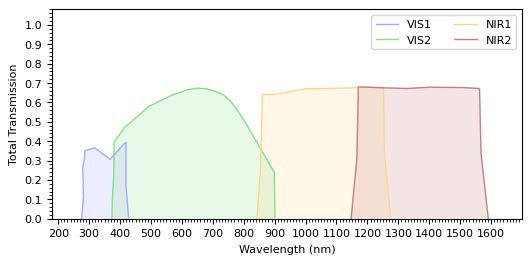
- Scientific concept: Simultaneous ultra-low surface brightness imaging in 4 channels (VIS1, VIS2, NIR1, NIR2)
- Spectral range: 280–1600 nm
- Optical architecture: Two quasi-identical binocular telescopes
- Aperture: 4 × 150 mm Maksutov–Cassegrain (f/10) telescopes
- Field of view: ~1.3° diameter (per channel), >1.15° common overlap
- Image quality: ~1–2 arcsec resolution (EE50 < 1.5 arcsec in VIS2)
- Pointing stability: 1 arcsec RPE (3σ over 10 min exposure, incl. FGS)
- Detectors:
- VIS: Teledyne-e2v CIS304-33 CMOS
- NIR: Teledyne H2RG (1.7 μm cut-off)
- Operating temperatures: ~200 K (VIS), ~150 K (NIR) with mK stability
- Thermal concept: Passive radiative cooling with active regulation (heaters + TCU)
- Straylight control: Multi-stage baffling system with heritage from CHEOPS/COROT
- Fine Guidance Sensor (FGS): NIR-based payload-in-the-loop attitude control
- Data handling: On-board processing with compression and slope reconstruction (NIR)
- Mass: ~160 kg total payload
- Power: ~100 W average, ~165 W peak
- Data volume: ~48 Gbit/day
- Structure: CFRP-aluminium honeycomb with titanium isostatic bipod mounts
- Heritage: Based on SATLANTIS iSIM170 concept adapted for space astronomy
- Development approach: Proto-flight model with EM/STM support and phased verification
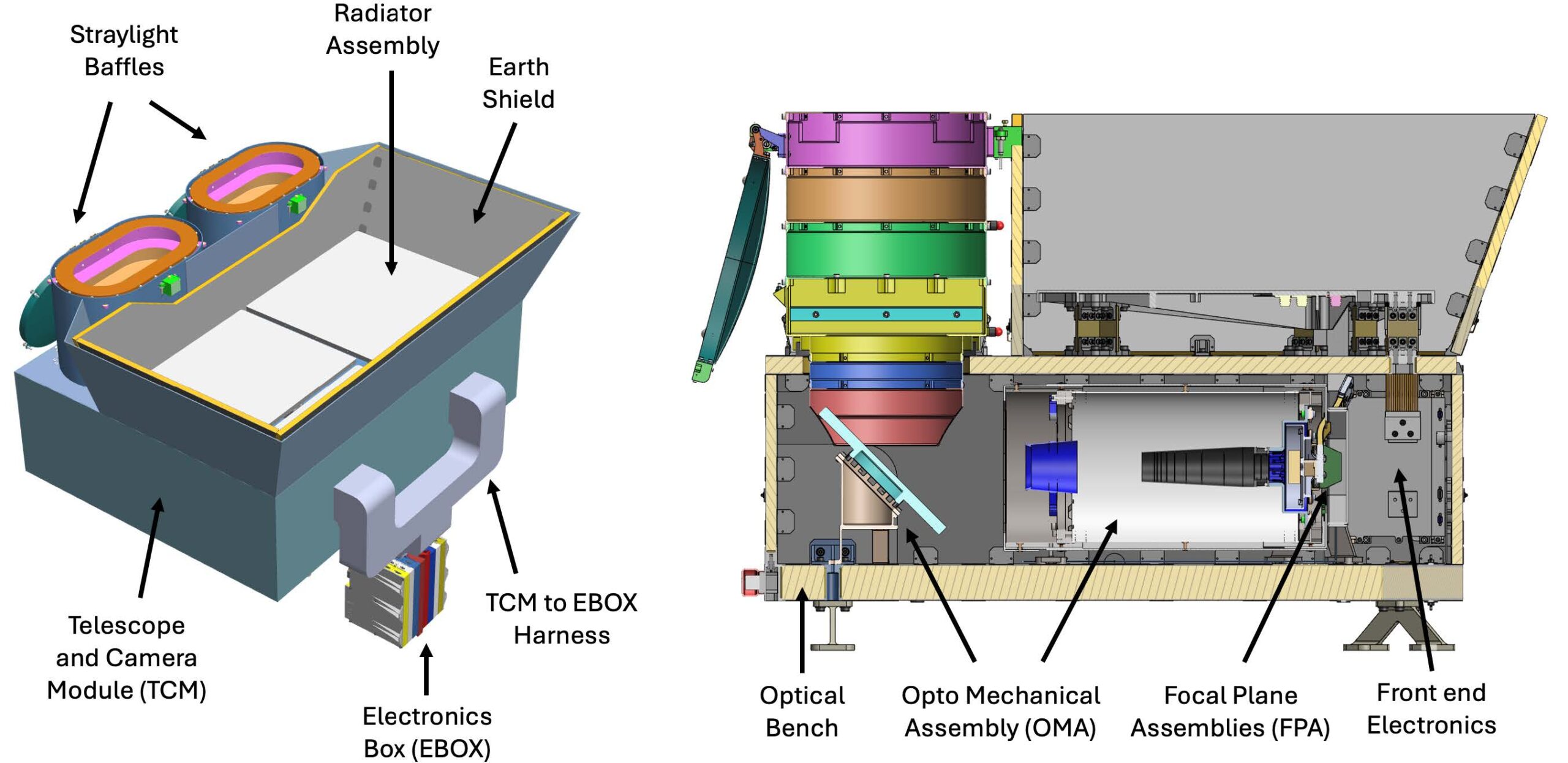
Instrument Concept and Architecture
The ARRAKIHS instrument concept is based on a modular architecture designed to enable simultaneous multi-band imaging with high optical stability, low straylight contamination, and stringent thermal control. The payload is structured into three main elements: Telescope and Camera Module (TCM), Electronics Box (Ebox) and Ground Support Equipment (GSE)
The TCM hosts all optical, mechanical, thermal, and focal plane subsystems and constitutes the science payload core. The Ebox provides all instrument control, power conditioning, data handling, and thermal regulation functions. The GSE supports integration, testing, calibration, and verification activities on ground.
The Telescope and Camera Module is the optical and detection core of the instrument. It contains the full optical path, including the binocular telescope assemblies, the focal plane systems, and the thermal and structural support elements. Its role is to collect incoming photons, form stable images across a wide field of view, and ensure that these signals are accurately delivered to the detectors under highly controlled thermal and mechanical conditions.
The Electronics Box is the central control and processing unit of the instrument. It is responsible for operating all subsystems, distributing power, processing scientific and housekeeping data, and managing communication with the spacecraft. It includes redundant units for instrument control (CDPU), power regulation (PSU), and thermal management (TCU), ensuring robust and continuous operation throughout the mission.
The Ground Support Equipment provides all necessary infrastructure for the assembly, integration, testing, and calibration of the instrument on ground. It supports optical alignment, electrical verification, environmental testing, and full system calibration prior to launch, ensuring that the instrument meets all performance requirements before deployment in space.
Subsystems
Here we provide an overview of the main subsystems of the ARRAKIHS science instrument, summarising their roles and key functions within the overall payload architecture. Each subsystem is described at a high level to support understanding of the instrument design and operation. Further detailed technical information can be found in the ARRAKIHS Definition Study Report (Red Book), which provides the complete system specifications, interfaces, and design analyses.
The Opto-Mechanical Assembly (OMA) is the optical core of the ARRAKIHS instrument and defines the complete photon path from entrance aperture to focal planes. It is based on two quasi-identical Maksutov–Cassegrain binocular telescopes with 150 mm apertures, providing simultaneous imaging in four spectral channels (see Figure on the right) over a 1.3-degree field of view. Folding mirrors redirect the incoming beam into the optical trains, enabling a compact configuration compatible with the spacecraft envelope.
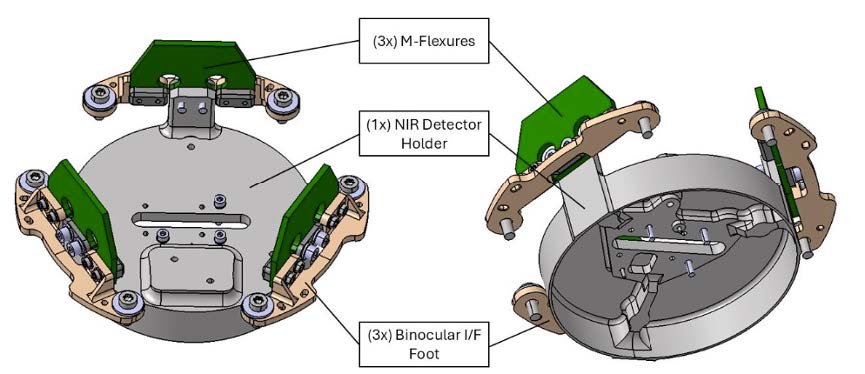
The Focal Plane Assembly (FPA) subsystem hosts the visible (CMOS) and near-infrared (H2RG) detectors, together with their proximity electronics and mechanical interfaces. It enables simultaneous four-channel imaging with operating temperatures of approximately 200 K (VIS) and 150 K (NIR), maintained with millikelvin stability.
The design ensures precise alignment, thermal decoupling, and low-noise performance. The NIR channels also provide the input for the Fine Guidance Sensor, supporting real-time spacecraft pointing corrections.
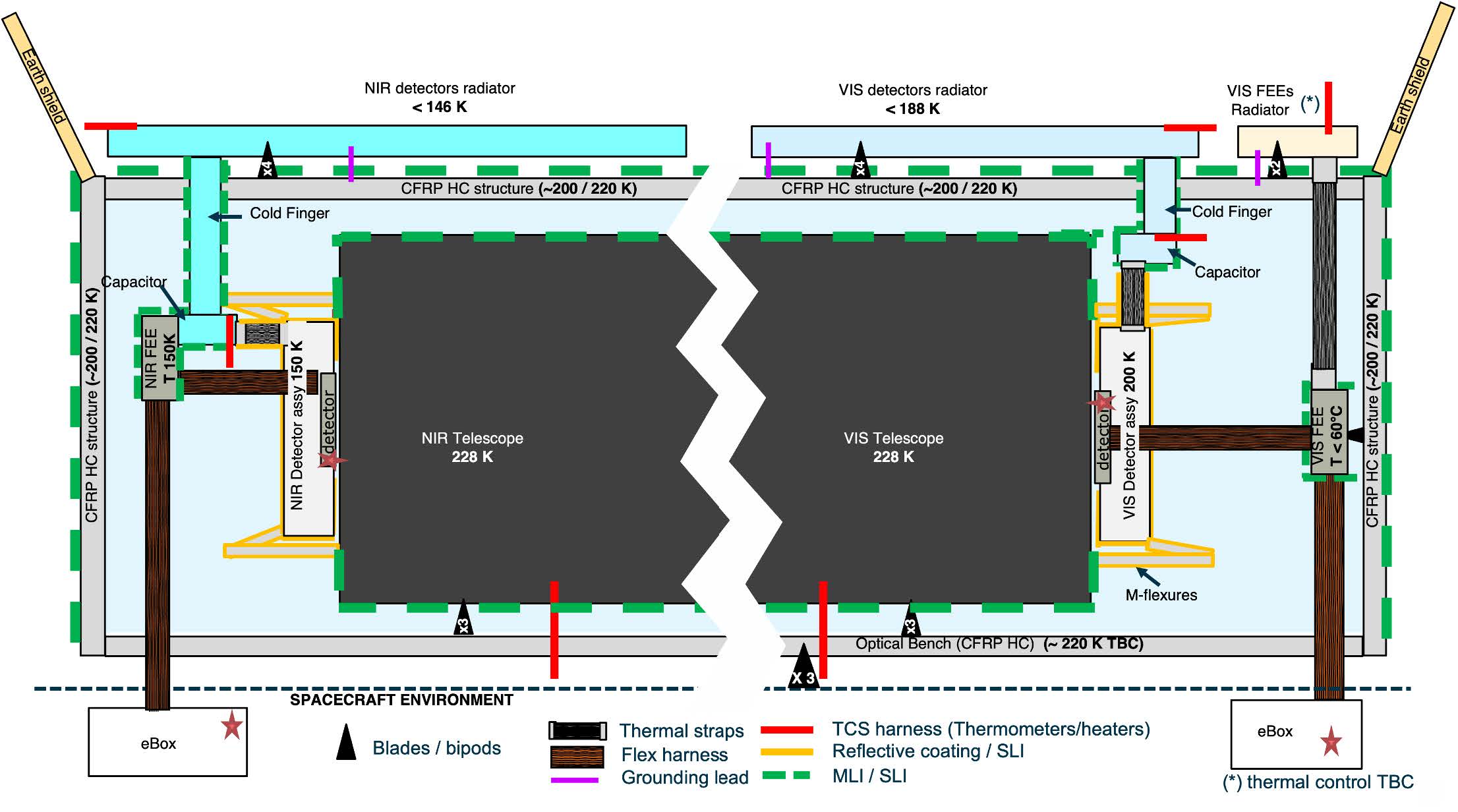
The Thermal and Structural Subsystem (TSS) provides the mechanical support and thermal control of the instrument. It is based on a CFRP–aluminium honeycomb structure mounted on three titanium bipods that ensure isostatic decoupling from the spacecraft.
Thermal stability is achieved through passive radiators, multi-layer insulation, Earth shielding, and active heater control via the Thermal Control Unit. This architecture minimises thermal gradients and preserves optical alignment and image stability during orbital operations.
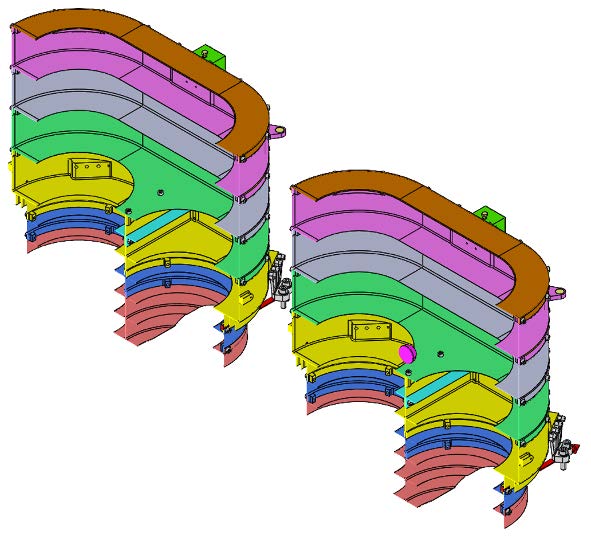
The Straylight Baffle Assembly (SBA) subsystem provides the first level of optical straylight suppression. It blocks off-axis radiation such as Earthshine and bright sources outside the field of view, ensuring a clean optical signal for ultra-faint surface brightness measurements.
The system uses a two-stage baffling architecture with internal vanes and low-reflectivity coatings. Deployable covers protect the optics during launch and early operations, preventing contamination and ensuring initial calibration stability.
The Electronics Box (Ebox) subsystem hosts all instrument electronics required for control, data handling, power distribution, and thermal regulation. It is located in the spacecraft service module and interfaces with the Telescope and Camera Module through dedicated harness connections.
The Ebox includes the redundant Control and Data Processing Units (CDPU), which manage instrument operations, detector sequencing, onboard processing, and communication with the spacecraft.
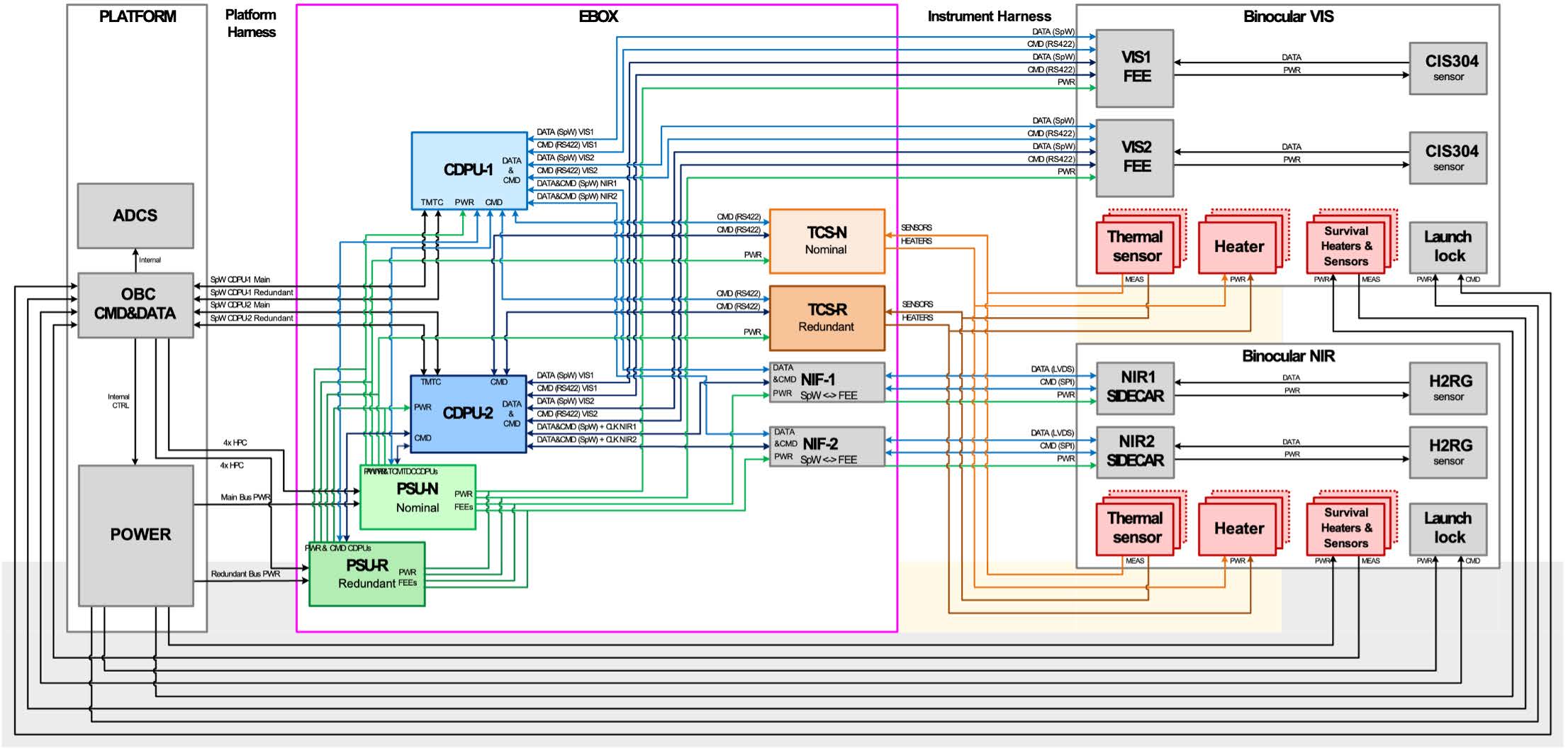
It also hosts the redundant Power Supply Units (PSU), which provide regulated and isolated power to all instrument subsystems, ensuring safe power distribution and fault protection.
Thermal control is performed by the redundant Thermal Control Units (TCU), which regulate the temperature of detectors, optical elements, and structural components using closed-loop heater and thermistor networks. In addition, the Near-Infrared Interface (NIF) boards provide low-noise power and data interfaces for the H2RG detectors, and perform partial onboard preprocessing of NIR data, including support for Fine Guidance Sensor operations.