
On-Ground Demonstrator
Contents
Technical Overview
Observations Plan
Data Reduction
The ARRAKIHS On-Ground Demonstrator (OGD) is a ground-based implementation of the camera system that will fly on the ARRAKIHS mission. Installed at the Javalambre Astrophysical Observatory (OAJ), it is used to validate observing strategies, calibration methods, and data-processing pipelines in a real astronomical environment before launch.
Although ground conditions differ from space, the OGD provides an essential end-to-end testbed for system validation, enabling scientific observations and stress-testing of reduction and calibration procedures. Since first light in April 2025, the system has been operated remotely by consortium members and has already accumulated a substantial dataset of representative science targets and calibration fields.
Technical Overview
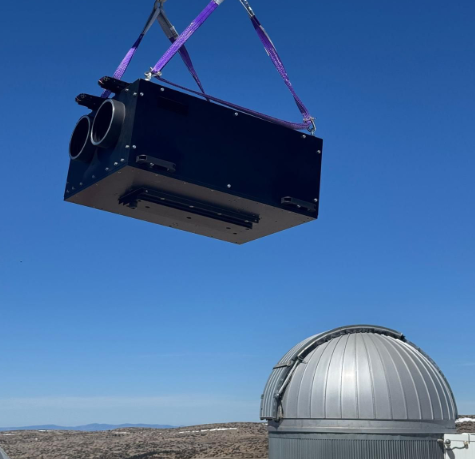
The heart of the OGD is the iSIM170 binocular camera, a system derived from the camera that will fly aboard ARRAKIHS. The OGD adapts the iSIM170 camera for ground-based operation while retaining aspects of its space design. It includes enhancements to ensure functionality in atmospheric conditions, enabling on-ground testing of the iSIM170’s optical, mechanical, and electronic systems under conditions that simulate its environment in space.
The OGD telescopes use a Maksutov-Cassegrain binocular design and provide a 1.5° field of view, enabling efficient imaging of extended, very low surface brightness structures such as galactic halos. The system operates in two simultaneous channels:
- a visible channel (350–900 nm) for scientific imaging,
- and a near-infrared channel (900–1700 nm) used for guiding and stabilising long exposures.
Both channels are optimised with dedicated detectors and coatings to ensure high transmission and low stray light, supporting sensitive observations of faint diffuse structures. The OGD also includes a protective cover and anti-dew thermal system, ensuring stable operation and image quality under varying and sometimes harsh nighttime conditions at the observatory.
Observations Plan
Since first light in April 2025, the OGD has been operated remotely by consortium members and is now running as a regular observing facility at the Observatorio Astrofísico de Javalambre. The system is used to observe representative ARRAKIHS science targets as well as calibration fields designed to test instrumental stability and data quality under realistic survey conditions.
To date, the OGD has accumulated several hundred hours of observations, including more than 220 hours on ~10 representative galaxies under optimal conditions for low surface brightness work, as well as over 150 hours obtained under non-optimal conditions to stress-test calibration and reduction strategies. A distributed team of remote observers operates the system continuously, including weekends and holidays, supported by on-site night staff.
The observations are specifically designed to validate dithering strategies, large-offset pointing, and long-integration stability, as well as to test performance in challenging conditions such as high background or stray light contamination.
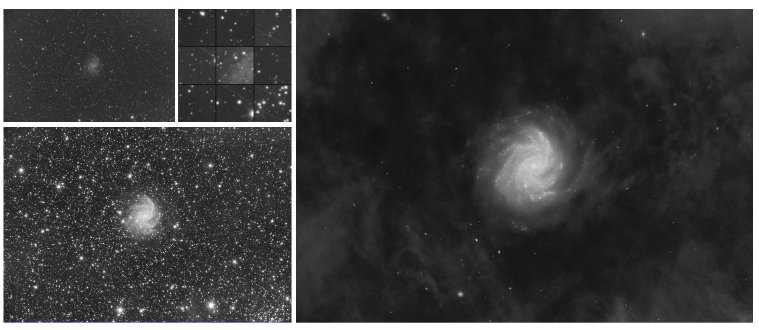
Science Demonstrations and Early Results. A representative stress-case analysis has been performed using NGC6946, a field strongly affected by Galactic cirrus and close to the Galactic plane. Although not part of the nominal ARRAKIHS target list, it provides an excellent test for straylight robustness and low surface brightness recovery under extreme background conditions. A preliminary 44-hour stack demonstrates both strong cirrus contamination and a stable large-scale optical response, with no visible degradation in PSF uniformity across the field.
A second target, NGC2460, has been used to evaluate low surface brightness performance. Preliminary reductions yield a measured surface brightness limit (mSBL) of approximately 28.77 mag/arcsec², with a detection threshold (SBdet) around ~28.6 mag/arcsec². These values are consistent with expectations from the mission design and are already comparable to deep ground-based surveys such as DES at similar depths. Although derived from simplified reductions not yet using the full HARVESTER implementation, these results confirm that the system operates in the required regime for low surface brightness science.
Photometric validation using Gaia G-band stellar magnitudes, including a quadratic colour correction, yields a preliminary zero point of ZP = 20.29 ± 0.25 mag, consistent with expected mission values. The OGD luminance bandpass lies approximately between the VIS1 and VIS2 flight filters. In addition, the preservation of faint galaxy structures in the presence of nearby bright stars (e.g. Gmag ~7 sources within arcminute scales) confirms excellent straylight control and stable large-scale optical response.
Data Reduction
OGD data will be recorded as FITS files at the Observatorio Astrofísico de Javalambre (OAJ) and transferred via dedicated fibre connection to the Unit for Processing and Data Archiving (UPAD) at CEFCA. From there, data will be forwarded to IFCA’s HPC facilities in Santander for long-term storage and processing.
Raw exposures will be processed into science-ready products using the ARRAKIHS HARVESTER pipeline, which will also serve as the core reduction framework for the full ARRAKIHS mission. The pipeline will perform standard calibration steps, including bias and dark correction, flat-fielding, astrometric and photometric calibration, and image stacking.
Given the specific nature of ground-based observations, the pipeline will include adaptations to account for atmospheric effects, such as seeing variations, extinction, and sky background fluctuations. These effects will be incorporated into the reduction strategy and later used to validate and refine the space-based processing approach.
Overall, the OGD provides a robust validation platform for both instrument performance and data processing strategies, bridging the gap between simulation, ground-based testing, and the final space mission configuration.