
The ARRAKIHS Survey
Contents
Target Pool definition
Survey Design
Photometric Coverage
The ARRAKIHS Survey is designed to obtain a homogeneous, statistically representative sample of Milky Way–mass galaxies in the nearby Universe. By observing a large population of galaxies with masses comparable to the Milky Way under uniform conditions, ARRAKIHS will connect the detailed knowledge gained from our own Galaxy with the broader population of galaxies in the local Universe. Its goal is to enable a population-wide study of faint stellar halos and low surface brightness features under uniform observational conditions, bridging the gap between Local Group studies and cosmological galaxy samples.
Target Pool definition
The ARRAKIHS target pool is constructed from large, uniform extragalactic catalogs, with the goal of selecting galaxies that are comparable to the Milky Way in stellar and halo mass.
The parent sample is based on the CS4G catalog, which provides homogeneous multi-wavelength photometric and structural information for galaxies in the Local Universe. From this dataset, the ARRAKIHS target pool is defined by selecting galaxies with:
- Stellar masses between approximately 10¹⁰ and 5 × 10¹⁰ solar masses, consistent with Milky Way–mass galaxies
- Morphologies consistent with disk-dominated or spiral galaxies
- Isolation criteria designed to ensure that nearby massive companions do not dominate the observed low surface brightness structures
- Distance range optimized for spatial resolution and surface brightness sensitivity
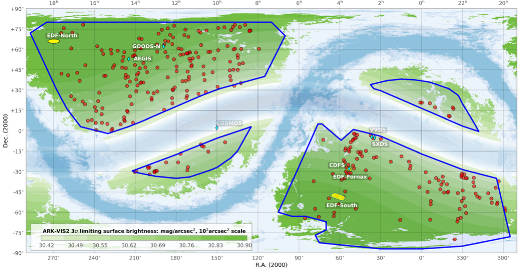
The target pool contains 192 galaxies that satisfy the scientific and observational requirements of the mission. From this pool, ARRAKIHS will observe a minimum of 80 galaxies during nominal operations.This sample size is driven by cosmological simulations, which predict a large diversity in the accretion histories of Milky Way–mass galaxies. A survey of approximately 80 targets is sufficient to sample both typical systems and the rare extremes of the population, enabling statistically meaningful studies of galaxy assembly histories and stellar halo properties.
Selection Criteria and Constraints
To ensure optimal detection of low surface brightness structures, additional observational constraints are applied to maximize data quality and minimize systematic effects.
Targets are selected to satisfy:
- Low Galactic extinction (typically E(B−V) < 0.1, with most targets below 0.05) to minimise contamination from Galactic cirrus
- High Galactic latitude to minimise foreground stellar density
- High ecliptic latitude to reduce zodiacal light background
- Distance range typically between ~20 and 40 Mpc
These criteria ensure uniform sensitivity across the survey and maximise detectability of faint extended structures such as stellar halos and tidal streams. The combination of space-based stability and consistent selection criteria enables a controlled dataset, where variations in observed properties can be attributed primarily to astrophysical differences rather than observational biases.
Survey Design and Region of Interest
For each galaxy, ARRAKIHS observes a physical region extending to a projected radius of 150 kpc, chosen to encompass the full extent of detectable low surface brightness structures. This scale is motivated by:
- Cosmological simulations showing that the vast majority of detectable low surface brightness features and stellar halo light lie within 150 kpc
- Observations of stellar streams and halo structures in nearby Milky Way–mass galaxies
- Surface brightness limits expected for ARRAKIHS observations
Within this region, ARRAKIHS will systematically map:
- Diffuse stellar halos
- Tidal streams and low surface brightness features
- Satellite populations associated with each host galaxy
The survey design ensures homogeneous depth and coverage across the full sample, enabling statistically robust comparisons of halo structure and assembly history. The final survey target list will be selected from the target pool using mission scheduling constraints together with scientific and observational priorities.
Together, these design choices define a statistically powerful dataset for connecting faint galaxy outskirts, stellar halos, tidal streams, and satellite populations to the assembly histories of galaxies and the structure of their dark matter halos.
Photometric Coverage
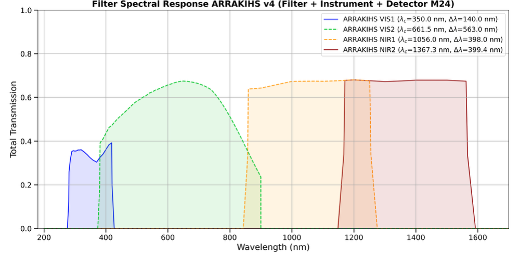
ARRAKIHS will observe all survey targets simultaneously in four broad photometric bands: two visible filters (VIS1 and VIS2) and two near-infrared filters (NIR1 and NIR2), providing continuous wavelength coverage from approximately 280 nm to 1.6 μm.
The two visible bands sample the 4000 Å break, a key feature of stellar populations that helps distinguish foreground and background sources. The bluer VIS1 band is particularly sensitive to young stellar populations, including star-forming dwarf galaxy candidates and residual star formation in stellar streams. This makes it easier to separate these components from the older, redder stars that dominate diffuse stellar halos.
VIS1 is one of ARRAKIHS’ most distinctive capabilities. Its sensitivity extends below 300 nm, a wavelength range not covered by comparable wide-field space missions such as Euclid or Nancy Grace Roman Space Telescope, nor by current ground-based facilities.
The two near-infrared bands complement the visible observations by tracing the light from older stellar populations in satellite galaxies, low-surface-brightness features, and diffuse stellar halos. They also provide more stable mass-to-light ratios, improving estimates of stellar mass in the outer regions of galaxies where these old populations dominate.
Together, the visible and near-infrared observations help distinguish genuine galactic structures from foreground Galactic cirrus. They also provide sensitivity to the ages and chemical compositions of stellar populations, allowing ARRAKIHS to characterize them in greater detail.
In regions that overlap with observations from Euclid, ARRAKIHS data will provide complementary depth, colour information, and spatial resolution. Combining both datasets will improve constraints on the faint-end satellite luminosity function and enhance studies of the low-mass galaxy population.