
Ground Segment
Contents
Instrument Operations
Data Reduction
Science Data Centre
- The Operations Ground Segment (OGS), fully managed by ESA, comprises the Mission Operations Center (MOC) and ESA’s tracking station network. The MOC is responsible for operating the ARRAKIHS spacecraft and handling data between the spacecraft and the GS.
- The Science Ground Segment (SGS), jointly operated by ESA and the ARRAKIHS Mission Consortium (AMC), and consisting of:
- ESA’s Science Operations Centre (SOC) is responsible for mission planning, archive management, and data distribution
- The Instrument Operations and Science Data Centre (IOSDC), operated by institutions across the ARRAKIHS consortium.
- Instrument Operations
- Data Reduction
- Science Data Centre
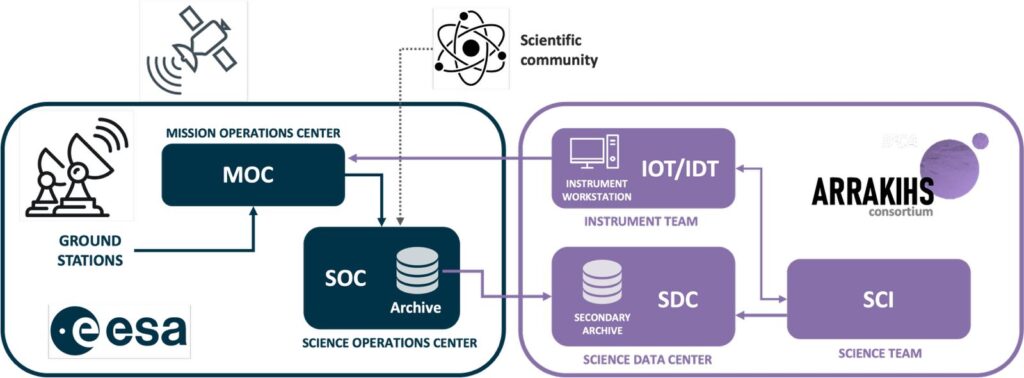
Instrument Operations
This area is responsible for the day-to-day execution of ARRAKIHS payload operations, carried out through the Payload Operations Centre (POC). The Payload Operations Centre comprises the Instrument Workstation (IWS) and the Payload Health & Performance Monitor. The facility will provide the means for running the monitoring and analysis tools and accommodating the personnel required. It will have the appropriate measures to guarantee the continuity of the activity in case of contingencies. These measures will include, but will not be limited to, hardware redundancies, backup of data storage, connectivity, power availability, etc.
It supports observing activities from preparation to routine operations, ensuring that instrument commands and configurations are correctly implemented and that operations follow defined procedures and constraints. During commissioning and routine operations, the team supports mission execution in close coordination with SOC and MOC, and ensures continuity of operations through maintenance of operational tools, procedures, and software. It also supports the maintenance of onboard and ground processing software required to transform raw instrument data into science-ready products.
Calibration. Calibration activities ensure that the instrument performance is well characterised and remains stable over time. This includes the definition of calibration strategies, selection of calibration targets, and execution of both on-ground and in-flight calibration activities. Those, begin before launch, when the instruments are characterized through extensive ground testing to establish the reference information required to process scientific observations and understand instrument behaviour.
Once in orbit, calibration becomes an ongoing activity. Environmental effects such as temperature variations and radiation exposure can gradually affect instrument performance. Regular in-flight calibration observations allow the mission team to monitor these changes and update calibration parameters whenever necessary.
Health and Performance Monitoring. Instrument health and performance are continuously monitored throughout the mission using telemetry and science data analysis. Dedicated monitoring tools track trends, detect anomalies, and provide early warning of potential performance degradation. A quick-look analysis system provides rapid assessment of data quality after each observation, supporting both routine monitoring and detailed investigation of anomalies when required.
Data Reduction
The IOSDC is also responsible for the development, validation, and maintenance of the software pipelines that transform Level1 data into higher-level science and calibration products. These pipelines are the core of the ARRAKIHS data processing system and ensure the production of scientifically validated data products used for analysis and public data releases.
The main processing system is the ARRAKIHS Harvester pipeline, which integrates all science and calibration processing stages in a consistent framework. It is designed to ensure reproducibility, traceability, and consistency across all data levels, from image processing to derived scientific products. The Harvester is executed by the Science Data Centre (SDC) for official data releases and also runs continuously on incoming data for validation and feedback to operations.
Science Data Centre
The Science Data Centre (SDC) provides the central infrastructure for the storage, processing, and management of ARRAKIHS scientific data products throughout the mission. It acts as the operational hub of the IOSDC data flow, ensuring that all data products are correctly ingested, processed, validated, and delivered to the SOC-managed science archive.
The SDC runs and supports the full data processing chain, including execution of the Harvester pipelines, maintenance of the internal data holdings, and operation of the Mission Parameter Data Base (MPDB), which serves as the central repository for mission configuration and processing parameters. Through the MPDB, the SDC ensures that processing parameters are version-controlled and traceable, enabling full reproducibility of scientific data products throughout the mission.
In addition, the SDC ensures controlled data access, metadata consistency, and reproducibility of all processing steps. It supports commissioning, routine operations, and legacy phases by maintaining the infrastructure, interfaces, and operational services required for continuous scientific exploitation of the mission data.