
The LSB Universe
Contents
What is it?
Why we observe it?
What can we learn from it?
What is the LSB Universe?
Beyond the bright central regions of galaxies lies a vast and extremely faint component known as the Low Surface Brightness (LSB) Universe. It includes the diffuse outskirts of galaxies, stellar halos, and a rich variety of substructures such as tidal streams, shells, and extended plumes of stars.
These features are not random. They are the visible remnants of past galaxy interactions, produced when smaller systems are gradually disrupted by the gravitational field of a larger galaxy. As these satellites are stretched and dissolved, they leave behind long-lived traces that preserve information about their original orbits, structure, and time of accretion.
Over time, some of this material becomes fully mixed into a smooth and diffuse stellar halo, while other components remain partially coherent as faint substructures. Together, they form a complex and layered record of a galaxy’s assembly history.
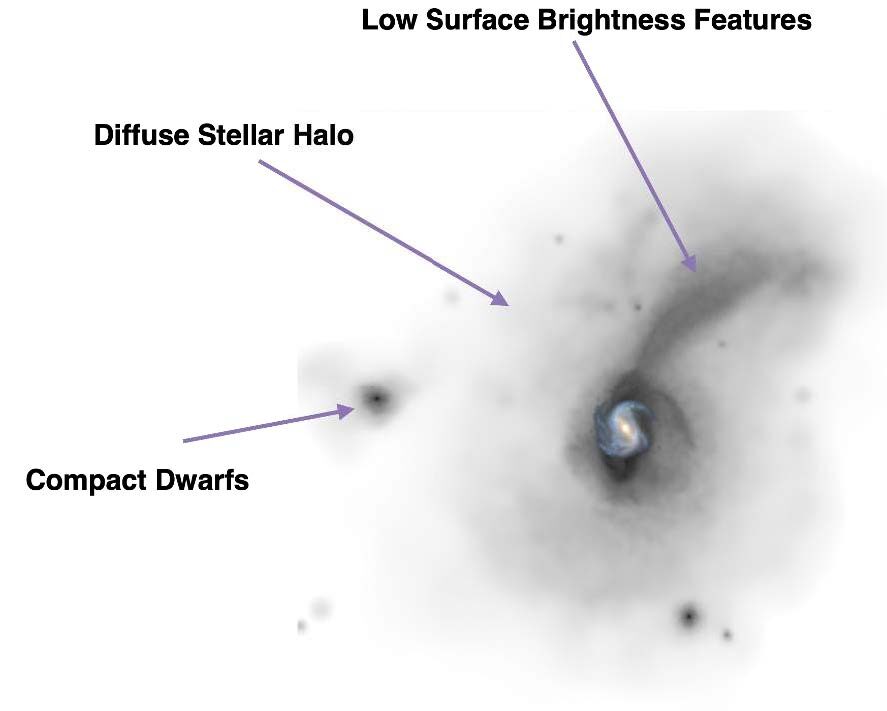
The LSB Universe therefore represents the outermost and most faint component of galaxies, where the signatures of past accretion events are still detectable, but only at extremely low brightness levels. When we look deeply enough into the faint edges of a massive galaxy, we expect to find three distinct features:
- Surviving Satellites: Small dwarf galaxies that have managed to survive the gravitational pulling so far.
- LSB Features (Streams & Shells): Recent tidal debris trapped in long, beautiful arcs and streams that trace the exact path of a destroying satellite.
- The Diffuse Stellar Halo: An ancient, smooth “fog” of stars made from older debris that has completely mixed together over billions of years.
Studying these ghost-like structures is the ultimate way to test our fundamental laws of physics and cosmology.
Why do we observe the LSB Universe?
The LSB Universe is a direct window into how galaxies grow over cosmic time. While the bright inner regions of galaxies are dominated by relatively recent star formation and internal evolution, the faint outskirts preserve the accumulated history of mergers and accretion events.
These regions are shaped primarily by gravitational interactions and the properties of the host dark matter halo. The way stellar material is stripped, dispersed, and mixed depends on the depth and shape of the gravitational potential, as well as on the mass, structure, and orbital properties of the accreted satellites. Studying the LSB Universe allows us to:
- Trace how galaxies assemble through the accretion of smaller systems
- Reconstruct the merger history of galaxies similar to the Milky Way
- Link observed stellar structures to the underlying dark matter distribution
- Understand how baryonic processes influence the survival and disruption of satellites
However, these structures are extremely faint and extended, often close to or below the limits of current observational capabilities. Their detection requires very stable imaging, extremely low background contamination, and large, homogeneous surveys of galaxy outskirts.
The Local Group provides a unique benchmark for studying these structures in exceptional detail. Its two main spiral galaxies, the Milky Way and Andromeda (M31), offer the deepest view of galaxy outskirts, thanks to the possibility of resolving individual stars. In the Milky Way, all-sky surveys have revealed a stellar halo rich in streams and substructures originating from disrupted dwarf galaxies and globular clusters. These include prominent features such as the Sagittarius stream, as well as many additional streams discovered in recent wide-area surveys. Together, they show that the Milky Way has experienced a complex assembly history, with early massive mergers followed by more recent, smaller accretion events. Around Andromeda, deep panoramic surveys have revealed a similarly rich outer halo, with numerous streams and substructures, including a prominent giant stream produced by the accretion of a relatively massive companion. These observations also show that M31 hosts an extended and diffuse stellar halo reaching large distances and containing a significant fraction of its stellar mass. Together, these two systems demonstrate that diffuse stellar halos and low surface brightness substructures are common features of Milky Way–mass galaxies, while also highlighting the diversity of their individual assembly histories.
Despite these breakthroughs in the Local Group, progress in the field has been limited by observational systematics and incomplete sampling of galaxy halos. Many known structures represent only the brightest subset of a much richer and more complex faint component that remains largely unexplored. The LSB Universe is therefore one of the key frontiers in extragalactic astronomy, where new observational capabilities are required to fully reveal the faint structure of galaxies and unlock their assembly history. Addressing these challenges requires a new observational approach. The ARRAKIHS mission is designed to overcome these limitations.
What we can learn from the LSB Universe
The faint outskirts of galaxies are not only a record of how galaxies formed, but also a powerful laboratory for testing fundamental physics. Because these regions are shaped by the underlying dark matter halo, different theoretical models of dark matter predict subtle but measurable differences in their structure. By mapping faint stellar streams and diffuse halos, we can probe the gravitational field of galaxies and test how dark matter is distributed on large scales.
At the same time, these structures are sensitive to the complex physics of galaxy formation. Processes such as star formation, gas cooling, and stellar feedback determine how small galaxies evolve and how easily they are disrupted. This, in turn, affects how much material is deposited into the faint outer regions of galaxies. By combining these observations, ARRAKIHS will link the visible structure of the low surface brightness Universe to the processes that govern galaxy assembly and to the role of dark matter in shaping galaxy outskirts.
In this way, the LSB Universe provides a direct connection between the smallest building blocks of galaxies and the largest-scale structure of the cosmos. See more details in ARRAKIHS Science Cases description.