
Synergies with other surveys
Contents
Euclid
Roman Space Telescope
Ground-based observations
ARRAKIHS is designed to explore the extremely low surface brightness (LSB) regime of galaxy haloes, where diffuse stellar structures such as tidal streams and extended halos become observable. In this regime, performance is not determined only by photon statistics, but by how well each survey controls systematic effects such as background subtraction, scattered light, and instrumental stability.
This leads to a key distinction when comparing surveys: the effective detection limit (SBdet), which reflects real observability after systematics, is often significantly brighter than the ideal photon-noise limit (pSBL). In many ground-based surveys, this difference can reach ∼1–1.5 mag arcsec⁻², while space missions can reduce it substantially through improved stability and calibration.
We consider here the main current and upcoming facilities relevant for LSB science: Euclid, the Nancy Grace Roman Space Telescope, and leading ground-based surveys such as LSST (Rubin Observatory), Dragonfly, LIGHTS, and SDSS. These surveys provide either wide-area coverage, high angular resolution, or deep imaging in selected fields. However, none of them simultaneously combines:
- systematics-limited depth in the LSB regime,
- homogeneous multi-band coverage from near-UV to near-IR,
- and full halo mapping for nearby Milky Way–mass galaxies.
ARRAKIHS is specifically designed to fill this region of parameter space.
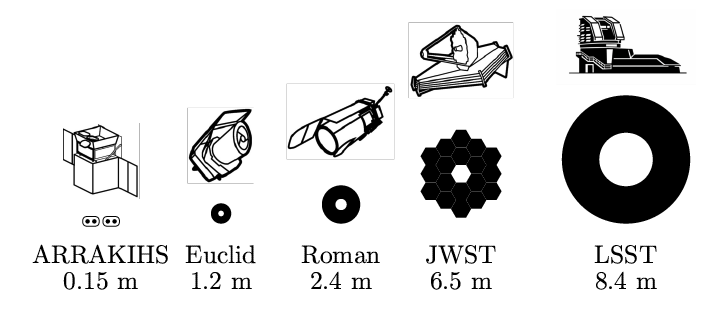
The relative scale of ARRAKIHS with respect to other major observatories is illustrated in the figure below, which compares primary mirror diameters across space- and ground-based facilities, including Euclid, Roman, JWST, and the Vera Rubin Observatory. While aperture size is only one aspect of survey capability, this comparison highlights the different design priorities of each mission. ARRAKIHS is optimized not for maximum resolution, but for ultra-low surface brightness stability over degree-scale fields.
Complementarity with Euclid
Euclid is the most relevant space-based survey for comparison with ARRAKIHS, both in terms of sky coverage and its capability to detect faint structures in galaxies. The mission combines a very large-area wide survey with deeper observations in selected fields, and therefore provides an essential reference for low surface brightness studies in the optical and near-infrared. Euclid and ARRAKIHS also share a significant fraction of their target sky area: all ARRAKIHS galaxies lie within the Euclid Wide Survey footprint, enabling direct access to Euclid imaging for the full sample. This makes Euclid a natural external dataset for calibration, background characterisation, and complementary structural analysis.
In the Euclid Wide Survey, the combination of a stable space environment and a well-characterized instrument allows excellent control of instrumental effects compared to ground-based facilities. However, the final detection limit for extended structures is still governed by residual large-scale systematics in the imaging and data reduction process.
Using homogeneous definitions of SBdet, derived from end-to-end simulations and validated observations, Euclid reaches typical systematics-limited depths of approximately:
- VIS band: SBdet ≈ 29.3–29.4 mag arcsec⁻² (Wide Survey)
where SBdet denotes the faintest surface-brightness level at which extended astrophysical structures can be robustly detecte. Deeper values are achieved in the Euclid Deep Fields, but these cover a small area and are not designed for nearby extended galaxy halos, which are the main target of ARRAKIHS.
ARRAKIHS reaches significantly deeper systematics-limited surface brightness levels:
- VIS2 band: SBdet ≈ 30.6 mag arcsec⁻²
- NIR1 band: SBdet ≈ 30.0 mag arcsec⁻²
- NIR2 band: SBdet ≈ 29.8 mag arcsec⁻²
This corresponds to a gain of more than ~1 magnitude in the optical regime compared to Euclid Wide Survey imaging. Importantly, this improvement is not only driven by exposure time, but by the survey design, optical configuration, and dedicated control of systematics in ARRAKIHS observations and data processing.
ARRAKIHS also adds a unique near-UV capability through its VIS1 band, extending the spectral coverage available for the study of faint galaxy halos. This additional colour information is particularly valuable for separating foreground Galactic cirrus from genuine extragalactic structures and for characterizing the stellar populations of streams, satellites, and diffuse stellar halos.
Complementarity with the Roman Space Telescope
The Nancy Grace Roman Space Telescope will provide high-resolution imaging over approximately 2,000 deg² using a suite of optical and near-infrared filters. While the overlap with the ARRAKIHS galaxy sample is expected to be more limited than for Euclid, the common targets will benefit from highly complementary observations. Roman excels at resolving compact structures within galaxy halos, including satellite galaxies, globular clusters, and inner halo substructures. ARRAKIHS complements these capabilities by tracing the diffuse stellar halos and tidal streams that extend over hundreds of kiloparsecs around galaxies.
The combination is particularly powerful in the near-infrared. ARRAKIHS reaches systematics-limited detection thresholds of approximately 30.0 mag arcsec⁻² in NIR1 and 29.8 mag arcsec⁻² in NIR2, enabling the study of faint diffuse stellar populations that are difficult to characterize through high-resolution imaging alone.
Complementarity with Ground-Based Surveys
Ground-based surveys provide an essential complement to ARRAKIHS by combining large sky coverage with extensive follow-up capabilities. Facilities such as the Vera C. Rubin Observatory, the Large Binocular Telescope, and the Dragonfly Telephoto Array are expanding our view of the low surface brightness Universe through deep imaging campaigns and large statistical samples. However, observations from the ground are fundamentally limited by atmospheric emission, scattered light, sky-background variations, and changing observing conditions.
ARRAKIHS avoids these limitations by operating in space, where the absence of the atmosphere provides a much more stable observational environment. This stability is essential for detecting the faintest stellar halos and tidal features. In addition, ARRAKIHS extends observations into wavelength regions that are inaccessible or highly challenging from the ground, including the near-ultraviolet and deep near-infrared regimes. This broader wavelength coverage enables improved characterization of stellar populations and more robust separation of foreground contamination.
Ground-based surveys therefore provide important context, follow-up observations, and complementary datasets, while ARRAKIHS delivers the homogeneous, ultra-deep measurements required to study galaxy assembly through diffuse stellar structures.
Mission Overview
Mission Design
ARRAKIHS Consortium


