Consortium members presented the latest advances preparing ARRAKIHS for its scientific journey.
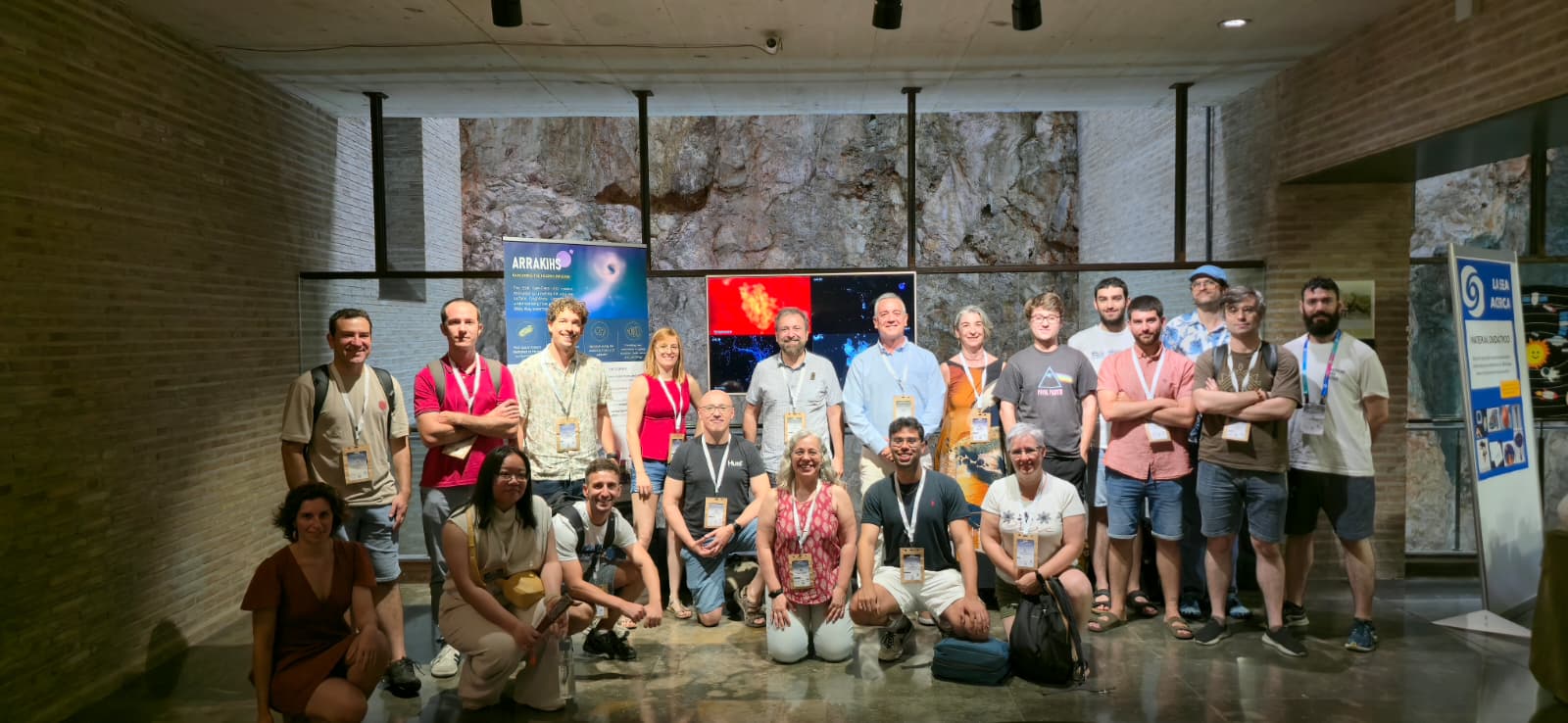
From 13 to 17 July 2026, members of the ARRAKIHS Consortium participated in the XVII Scientific Meeting of the Spanish Astronomical Society (SEA 2026), one of the largest gatherings of the Spanish astronomical community. Held every two years, the meeting brings together researchers from across Spain and abroad to present the latest advances in astronomy, astrophysics, instrumentation and space missions. ARRAKIHS had a strong presence at this year’s meeting, with six oral presentations and two posters showcasing the scientific and technological developments currently underway across the mission.
Several talks highlighted the science that ARRAKIHS will enable and the tools being developed to maximise its scientific return. Raúl Infante (CEFCA) presented new analysis techniques capable of detecting extremely faint diffuse structures in realistic ARRAKIHS simulations, while Juba Barrios (UCM) introduced a machine-learning pipeline to identify dwarf satellite galaxies in simulated observations. Li-Wen Liao (IEEC-ICE) explored how different dark matter models and baryonic physics affect Milky Way-like galaxies using the DREAMS simulations and ARRAKIHS mock images, and Abram Pérez (IFCA, CSIC-UC) presented simulations investigating the detectability of tidal streams from dwarf satellite galaxies. Together, these studies demonstrate how the consortium is preparing to answer fundamental questions about galaxy formation and the distribution of dark matter.
The mission itself was also prominently featured during the conference. Rafael Guzmán (IFCA, CSIC-UC), Principal Investigator of ARRAKIHS, presented an overview of the mission, its scientific goals and current status, while Pablo Renard (IEEC-ICE) discussed one of its major technological challenges: the calibration strategy required for the mission’s cameras to achieve the sensitivity needed to detect ultra-low-surface-brightness structures.
ARRAKIHS was also represented in the poster sessions. Alejandro Camazón (IEEC-ICE) presented work on the scientific synergies between ARRAKIHS and Euclid for exploring the ultra-low surface brightness Universe, while Noelia Grande (UCM) showcased ATREIDS, the observation management tool being developed to support mission operations.
The conference also featured contributions from consortium members Asier Lambarri (UCM), Ramón Rodríguez-Cardoso (UCM) and Santi Roca-Fàbrega (LU), who presented research based on cosmological simulations and the analysis of galaxy evolution. These studies provide the theoretical context needed to interpret future ARRAKIHS observations and further strengthen the mission’s scientific case.
The broad range of contributions presented at SEA 2026 reflects the multidisciplinary nature of ARRAKIHS and the collaborative work being carried out across the consortium. As the mission progresses, meetings such as the SEA provide an excellent opportunity to share developments with the astronomical community, strengthen collaborations and prepare for the exciting science that ARRAKIHS will deliver in the years to come.