Performance & Simulations

Contents

Sensitivity

Image quality

End-to-End simulations

Instrument Performance

The ARRAKIHS instrument is designed to measure extremely faint structures in galaxy outskirts, reaching surface brightness levels beyond 30 mag/arcsec². Its performance is driven by three key elements: how much light is collected, how efficiently it is preserved through the system, and how cleanly it can be separated from noise and background signals.

Throughput and light efficiency. The total signal recorded by the instrument depends on the combined efficiency of the full optical system, from the telescope mirrors to the detectors. This includes: mirror reflectivity and coating performance, filter transmission across VIS and NIR bands, absorption and scattering in optical elements and detector quantum efficiency.

Performance has been evaluated using different fidelity levels, from conservative manufacturer specifications to a current best estimate (CBE) based on heritage and measured component behaviour. This refined modelling leads to a significant improvement in expected throughput, particularly in the visible channels, where faint surface brightness detection is most demanding.

Advanced coatings (including dielectric mirror options) further increase efficiency in the VIS range and are currently under assessment.

Sensitivity to low surface brightness. The key performance driver of ARRAKIHS is its ability to detect extremely faint extended emission embedded in bright and structured backgrounds. The limiting sensitivity is set by the combination of: zodiacal light, Galactic diffuse emission and cirrus, straylight from bright sources, optical ghosts and scattering, detector noise (read-out, dark current, PRNU), Earthshine (specific to low-Earth orbit operation).  When all contributions are combined, the instrument achieves a 3σ co-added surface brightness limit of:

  • VIS: ~30–30.6 mag/arcsec²
  • NIR: ~29.3–29.7 mag/arcsec²

These values define the regime where faint stellar halos and accretion signatures become detectable.

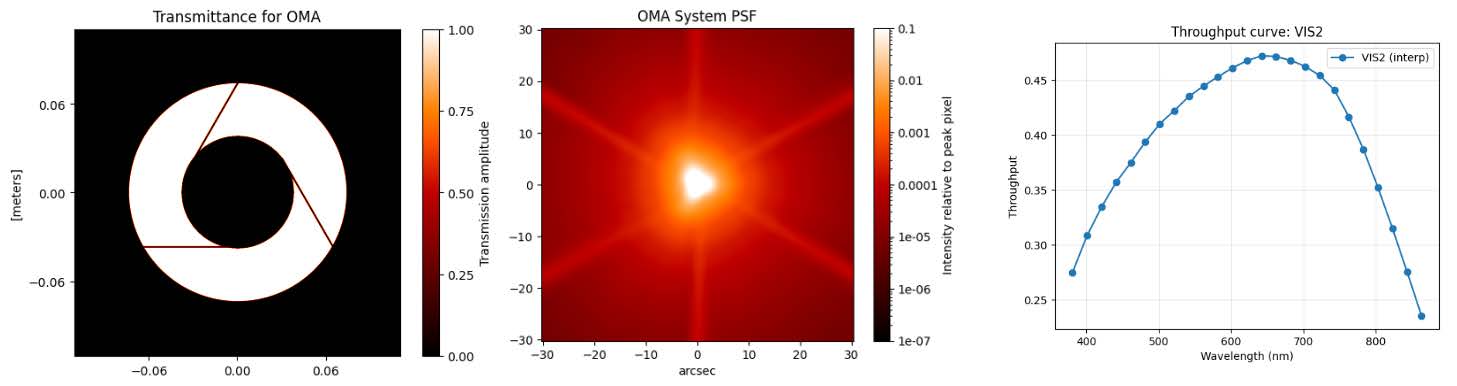
Simulated Pupil (left) and VIS2 PSF from the IQ analysis (middle). Right: System Throughput for the Polychromatic PSF simulation.

Image Quality. Image quality determines how well faint structures can be resolved spatially and separated from instrumental effects. The final point spread function (PSF) is shaped by: diffraction in the optical system, wavefront errors from manufacturing and alignment, spacecraft jitter during exposures, detector sampling and pixel response. 

The resulting PSF is stable across bands, with a well-controlled core and extended wings that are explicitly modelled in the data reduction chain. This ensures that faint structures are not artificially suppressed or redistributed by the instrument response.

Straylight control. At the surface brightness levels targeted by ARRAKIHS, straylight becomes a critical performance driver. The instrument is designed to minimise and model contributions from: internal reflections (ghosts), scattering from optical surfaces, diffraction wings, external illumination sources (stars, Earth, zodiacal light). 

A dedicated baffling system and optical design reduce contamination, while detailed modelling ensures residual effects are well characterised for calibration and removal.

End-to-end simulations

To validate the ARRAKIHS performance, we build realistic end-to-end simulations of the full observing process: from the astrophysical sky to the final science-ready images. These simulations are not only a technical test of the instrument, but a way to verify that extremely faint structures in galaxy outskirts can be reliably detected, measured, and separated from background and instrumental effects.

Simulations are carried out using a complete end-to-end framework that reproduces both the sky and the instrument response:

  • ATREIDS generates realistic raw detector images as they would be observed in orbit
  • HARVESTER processes these images through calibration and scientific reduction

Together, they form a closed loop that connects mission design, instrument performance, and final science extraction.

The simulated sky includes all major astrophysical and environmental components expected in orbit: background galaxies from cosmological simulations, Milky Way stellar populations, Galactic cirrus and diffuse emission, zodiacal light variations along the orbit, Earthshine contributions specific to low-Earth orbit.

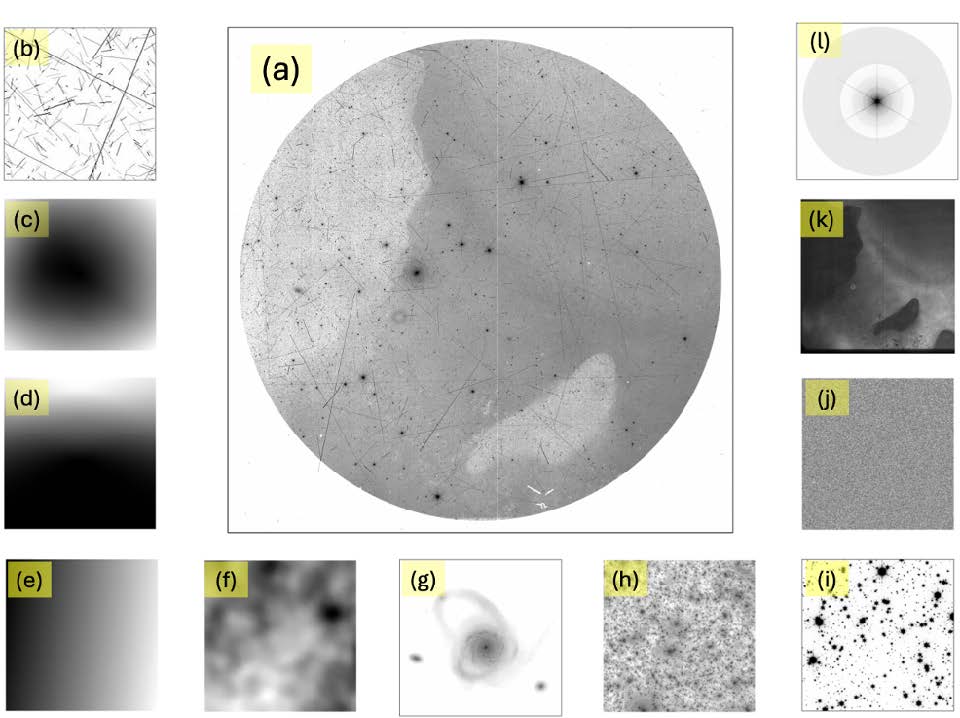
On top of the astrophysical model, the full instrument response is applied, including: optical PSF and extended wings, wavefront errors and jitter, ghost reflections and scattering, detector noise (read-out, dark current, Photo Response Non-Uniformity (PRNU)), cosmic rays and transient events (see Figure below).  This ensures that simulations reflect the actual measurement process rather than an idealised image.


Summary figure of ATREIDS: (a) Result of a simulation of a RAW 10-minutes exposure time image in VIS2 filter using iSIM-170. (b) Cosmic Rays effect included in the simulation, affecting 7% of the pixels. (c) Straylight coming from all the stars around the FOV of the telescope. (d) Straylight coming from the Earth due to its albedo during the exposures. (e) Incoming Zodiacal light. (f) Galactic extinction map from Planck Collaboration et al. (2016). (g) Galaxy Model from Firebox simulations transformed into light. (h) Cosmological background from Flagship simulation (Euclid Collaboration et al., 2025). (i) Stars within the FOV from Gaia catalog (Gaia Collaboration et al., 2023) and the Besancon Galaxy model (Czekaj et al., 2014). (j) Simulated dark frames using Pyxel (Arko et al., 2022) . (k) PRNU Map from a detector used in Pyxel. (l) Point Spread Function (PSF) model of iSIM-170 including the M2 spider with ghosts due to inner reflections.

ATREIDS produces raw detector frames that mimic real observations, including all sky and instrument contributions. These are then processed by HARVESTER, which performs calibration, background subtraction, and coaddition to recover faint extended emission. This end-to-end approach ensures that the mission performance is tested under realistic conditions, confirming that faint stellar halos and accretion features remain detectable after full data reduction.

Science Feasibility

Studies of the Low Surface Brightness (LSB) Universe are limited primarily by systematic effects rather than by statistical noise. At the extremely faint surface brightness levels...

On- ground demonstrator

The ARRAKIHS On-Ground Demonstrator (OGD) is a ground-based implementation of the camera system that will fly on the ARRAKIHS mission. Installed at the ...

Mission Overview

ARRAKIHS is an ESA F-class mission (F2) designed to address a central Cosmic Vision question: how galaxies assemble their mass and structure through hierarchical accretion.