
Mission Desing & Spacecraft
Contents
Mission Concept
Observation Strategy
Spacecraft
Mission Concept
The ARRAKIHS mission is designed to enable ultra-deep, multi-band imaging of the faint outskirts of nearby Milky Way–like galaxies. Its mission architecture combines a stable low-Earth orbit, a highly efficient observing strategy, and a compact multi-telescope payload optimised for extremely low surface brightness (LSB) sensitivity.
The overall mission concept is illustrated in the Figure below and spans four main elements: the mission profile and observing strategy, the spacecraft design, the development and verification approach, and the launch strategy.
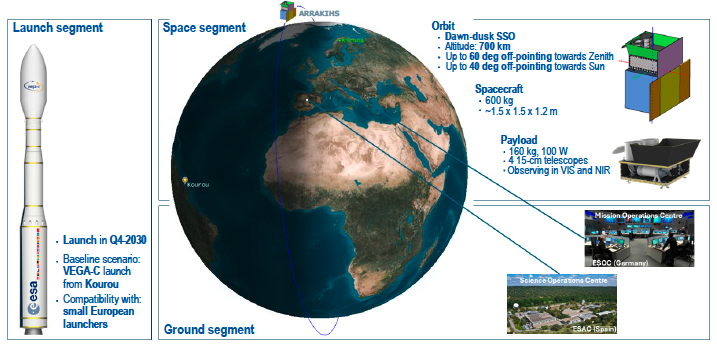
ARRAKIHS will operate in a Low Earth Orbit (LEO), in a dawn–dusk Sun-synchronous orbit at an altitude of approximately 700 km. This orbit provides stable illumination conditions throughout the year, ensuring thermal stability of the instrument and highly efficient operations for faint surface brightness imaging. The orbit has been selected through a trade-off between observational performance, space environment constraints, and mission lifetime requirements. In particular, the 700 km altitude offers: a low and stable radiation environment, reduced atmospheric drag effects, good stray-light control conditions, and compatibility with European launch options and space debris mitigation rules.
The spacecraft is designed for a nominal 3-year science mission, with a minimum target sample of ~80 galaxies, and is compatible with a potential mission extension of at least 2 additional years. Launch is currently planned for 2030, with a baseline scenario of a VEGA-C launch from Kourou, and compatibility maintained with other emerging European small launchers.
After launch, the mission follows a standard sequence:
- Launch and Early Operations Phase (LEOP)
- In-orbit Commissioning (IOC)
- Science Performance Verification (~1 month)
- Nominal Science Operations (3 years)
At the end of operations, the spacecraft will be safely de-orbited in compliance with European space debris mitigation requirements.
Observation Strategy
The mission is based on a targeted observing strategy designed to reach surface brightness limits fainter than 30 mag/arcsec² in the VIS band, enabling the detection of extremely diffuse structures such as stellar halos, tidal streams, and ultra-faint satellite features. Each galaxy is observed through multiple visits composed of 10-minute exposures, later combined on ground to build ultra-deep images. A typical target receives a total integration time of approximately 150 hours, distributed across multiple observing visits to optimise sky coverage, calibration, and systematics control.
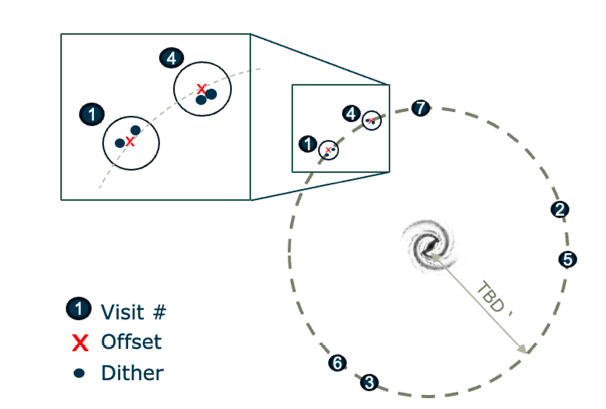
The mission is based on deep, multi-band imaging of a carefully selected sample of approximately 80 target galaxies, representative of Milky Way–mass systems in the Local Universe (see the ARRAKIHS survey for selection details). To ensure uniform depth and robust control of systematic effects, observations are split into multiple visits with small pointing offsets and intra-visit dithers (see Figure below). This strategy serves several key purposes:
- improves background subtraction stability over large spatial scales
- reduces the impact of detector defects and flat-field residuals
- enhances sampling of the point spread function (PSF)
- increases robustness against transient artefacts and foreground contamination
As a result, the final stacked images are not simple co-additions, but the outcome of a carefully designed observing pattern optimised for ultra-low surface brightness science.
Spacecraft
The ARRAKIHS spacecraft is a compact, stable and highly agile platform specifically designed to enable ultra-deep imaging of extremely low surface brightness structures in nearby galaxies. Its architecture is driven by a single requirement: maximising photometric stability over long exposures while maintaining efficient survey operations across a large target sample.
The spacecraft hosts a payload composed of four 15-cm telescopes operating in optical and near-infrared bands. The instrument is mounted on the upper part of the spacecraft to ensure an unobstructed field of view and stable thermal conditions. Two dedicated shielding elements — a Sun shield and an Earth shield — isolate the payload from external thermal variations and stray light, ensuring the long-term stability required for ultra-faint surface brightness measurements.
The spacecraft is designed to achieve a relative pointing stability of approximately 1 arcsecond (3σ) during 10-minute exposures. This performance is enabled through:
- high-precision star trackers
- reaction wheel-based attitude control
- fine guidance information provided by the instrument during science operations
In addition to stability, the spacecraft is highly agile, allowing rapid slews between targets to efficiently execute the survey within the nominal mission lifetime.
ARRAKIHS produces a continuous stream of imaging data that is downlinked daily to ground stations using X-band communications. The spacecraft is designed to transmit approximately ~50 Gbit of science data per day, compatible with a single primary ground station architecture. On-board systems manage autonomous execution of observation sequences, time tagging, and data integrity, enabling efficient operations with minimal intervention during routine science phases.
The spacecraft has a total launch mass of approximately 600 kg and a compact configuration of about 1.5 × 1.5 × 2 m, making it compatible with a range of European small launchers, including the baseline VEGA-C launch scenario for 2030. The design prioritises simplicity, robustness, and the use of flight-proven technologies wherever possible, reducing development risk while ensuring compatibility with mission schedule and cost constraints.
Industrial implementation. The spacecraft is currently being developed in parallel by two industrial consortia led by Redwire and AVS, as part of the Phase A/B competitive study. Both teams implement the same mission requirements within a common architectural baseline, while exploring alternative detailed solutions for subsystem implementation. This dual-track approach increases design robustness and reduces programmatic risk. The final spacecraft configuration will be consolidated after mission adoption, following selection of the prime contractor.