
Science Feasibility
Contents
End to End Simulations
Control of Systematics
Detection capability
Studies of the Low Surface Brightness (LSB) Universe are limited primarily by systematic effects rather than by statistical noise. At the extremely faint surface brightness levels where stellar halos and tidal streams become detectable, uncertainties arising from sky background variations, instrumental effects, and data processing dominate over simple photon-counting (Poisson) noise.
These systematics include contamination from unresolved background galaxies, foreground stars, Galactic cirri, zodiacal light, Earthshine, and instrumental effects such as scattered light, ghost reflections, and the extended wings of the point spread function (PSF). Together, they define the practical limits of current observational capabilities.
Simulating the full observational problem
To assess the feasibility of ARRAKIHS science goals, we have developed an end-to-end simulation framework that reproduces the full observational process, from theoretical galaxy models to final processed images. This framework combines:
- cosmological simulations of Milky Way–mass galaxies,
- realistic modelling of stellar halos and tidal features,
- detailed instrument performance,
- and all relevant astrophysical and instrumental sources of contamination.
The resulting simulated observations are processed using the same strategy and analysis pipeline that will be applied to real mission data. This approach allows us to directly test whether faint structures such as Low Surface Brightness Features (LSBFs) and Diffuse Stellar Halos (DSHs) can be reliably detected under realistic conditions.
The simulations include all major sources of contamination expected in the ARRAKIHS survey: background galaxies across cosmic distances, foreground stars in the Milky Way, Galactic cirri from diffuse dust emission, zodiacal light and Earthshine, cosmic rays, and instrumental effects such as PSF scattering and optical ghosts.
By incorporating these components simultaneously, we reproduce the main sources of complexity present in real observations in the low surface brightness regime.
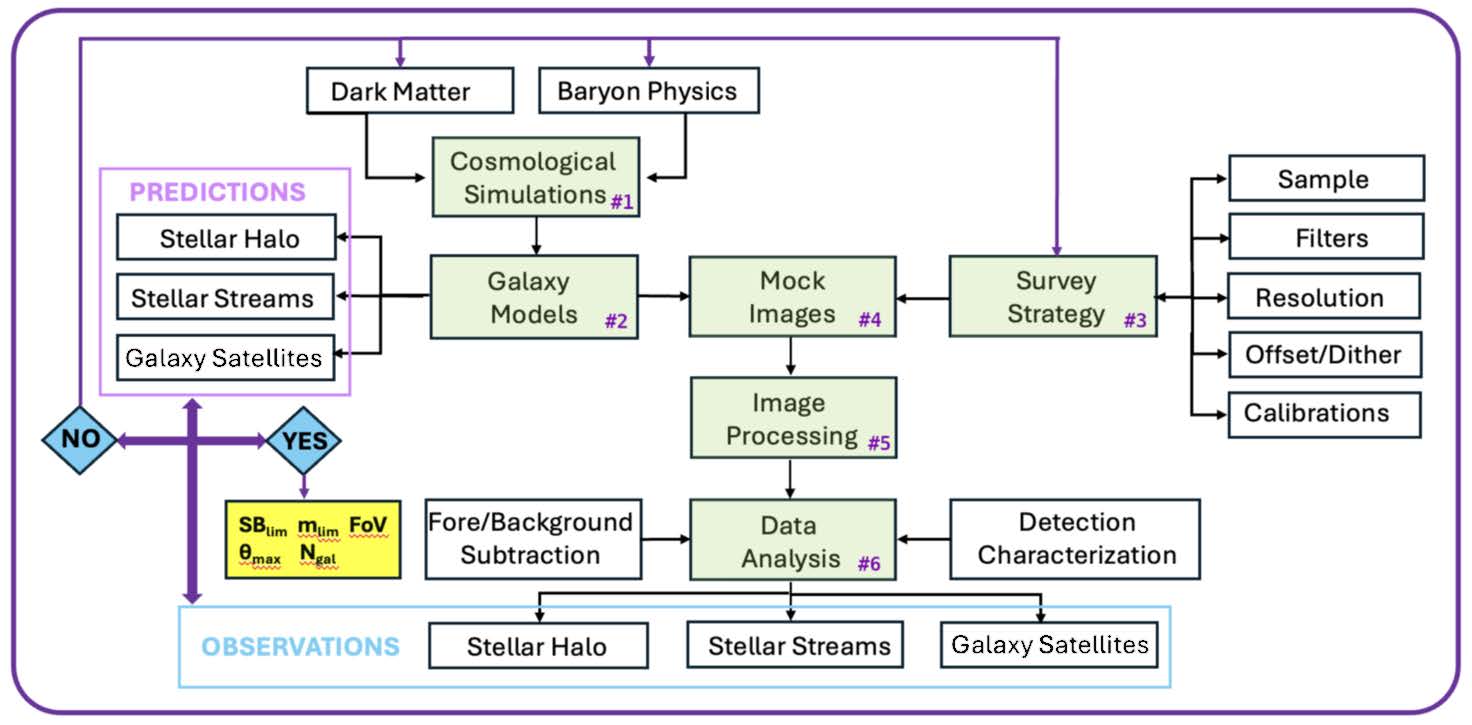
Next-generation simulation framework: HARKONENS
In addition to the current end-to-end simulation framework, ARRAKIHS will benefit from the development of the HARKONENS simulation suite, designed specifically to expand and refine the physical realism of the input galaxy population. HARKONENS will provide a new generation of high-resolution cosmological simulations tailored to ARRAKIHS science goals, extending the current modelling space to include different dark matter scenarios (CDM, WDM, SIDM) and a broader range of baryonic feedback prescriptions. This will significantly improve the statistical representativity and physical diversity of the mock Milky Way–mass galaxy sample.
In the end-to-end simulation flow chart above, HARKONENS will constitute operation #1 (Cosmological Simulations), replacing the current set of simulation inputs used to initialise the pipeline. By varying the input parameters of the simulations, we explore how galaxy properties depend on the underlying physical model assumptions. When integrated into the ATREIDS + HARVESTER pipeline HARKONENS will enable a more comprehensive exploration of how underlying galaxy formation physics maps onto observable low surface brightness structures, with a more robust end-to-end validation framework.
Understanding and controlling systematics
A central goal of this feasibility analysis is to quantify the impact of the main sources of systematic contamination affecting the detection of faint stellar structures, and to assess the effectiveness of the mitigation strategies implemented within the end-to-end pipeline. The dominant systematics considered are: foreground Galactic cirri, background astrophysical sources, instrumental ghost reflections, and the extended wings of the PSF. Using the resources and modelling capabilities currently available within the end-to-end simulation framework, we find that:
- foreground cirri can be largely mitigated through careful target selection and multi-band colour information, reducing contamination to ≲5–10% of affected fields in the final sample selection;
- background sources can be identified and removed using high-resolution reference data and machine learning-based cleaning techniques, achieving residual contamination levels below ∼10% in area fraction at the lowest surface brightness regime;
- instrumental ghosts can be modelled and subtracted to a level where residuals remain below the detection threshold, with typical residual surface brightness levels fainter than ∼31.5 mag arcsec⁻², well below the effective detection limit of the survey;
- the extended wings of the PSF can be characterised sufficiently well to avoid biasing the measurement of faint structures, with subtraction residuals contributing less than ∼1–2% of the sky background signal in the relevant radial range.
Importantly, after all corrections, residual systematic effects remain below the surface brightness levels required for the detection of the targeted signals. In particular, the effective detection regime of ARRAKIHS (around ∼30–30.6 mag arcsec⁻² in VIS) remains safely above the residual systematic floor in all major contamination sources. For further technical details please see the ARRAKIHS Definition Document (Redbook).
These results are obtained in a simplified simulation context, where not all systematic effects are simultaneously modelled at full fidelity and where the data reduction pipeline is still under active development. Nevertheless, dedicated tests including partial Harvester processing and injected residual systematics indicate that the impact of the dominant instrumental effects remains sub-dominant with respect to the expected detection thresholds.
Demonstrating detection of low surface brightness structures
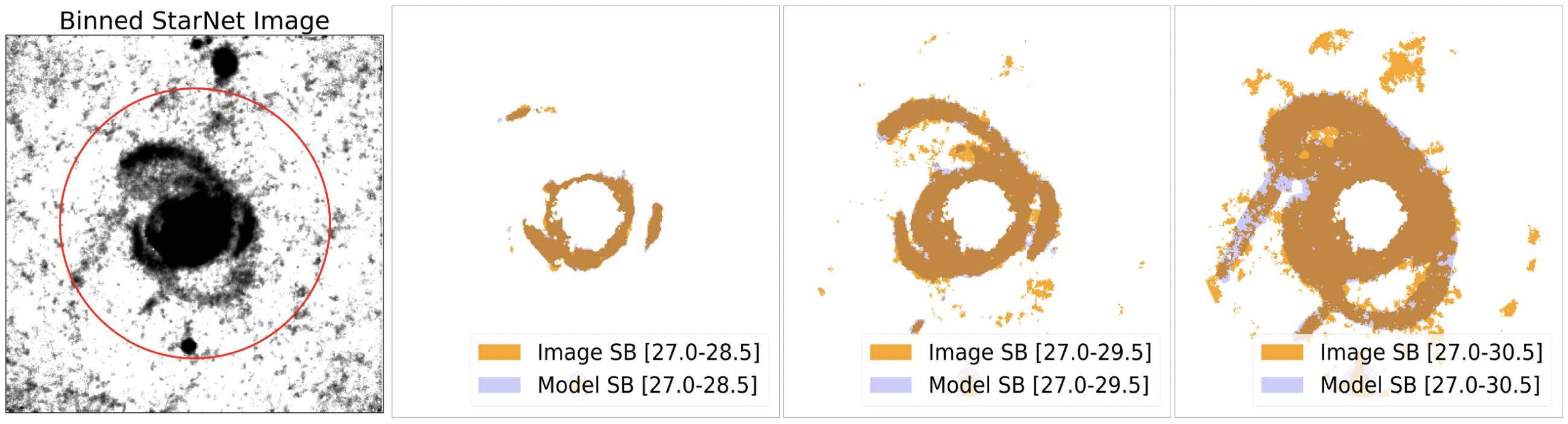
Detecting faint stellar structures. After applying realistic contamination modelling and data processing, LSBFs and stellar halo structures are successfully recovered in simulated ARRAKIHS observations. The analysis shows that tidal streams and diffuse halo structures are consistently detected across a representative sample of galaxies, with reliable recovery of features down to surface brightness levels of ∼30–30.6 mag arcsec⁻² in the VIS bands (see Figure below). At these limits, faint substructures remain identifiable, with typical detection completeness of ∼80–90% at the brighter end of the low surface brightness regime, gradually decreasing toward the survey limit as expected. Contamination from false detections remains controlled at the level of ≲10%, and can be further reduced using multi-band colour information and signal-to-noise selection criteria.
Morphological and photometric properties of detected structures can be robustly measured, including shape, extent, integrated flux, and colours. The resulting colour accuracy remains better than ∼0.1–0.15 mag in the regime relevant for LSB detection, enabling constraints on stellar population properties such as age and metallicity.
Sensitivity to diffuse stellar halos. In addition to discrete structures, ARRAKIHS recovers smooth diffuse stellar halos through radial surface brightness profiles that extend to ∼100–150 kpc around Milky Way–mass galaxies. These profiles can be measured down to surface brightness levels of ≲31 mag arcsec⁻² in the outer halo regions, allowing the characterization of the faint accreted component that dominates the stellar halo mass budget.
Survey performance and completeness. Simulations indicate that detection efficiency remains high at the surface brightness levels relevant for ARRAKIHS science goals, with a gradual decline toward the faintest regime. Overall completeness and contamination levels are well balanced for robust scientific exploitation of the survey.
Future work
The next phase of ARRAKIHS will build on the current feasibility results by moving towards fully realistic end-to-end simulations and analysis tools after mission adoption. We will generate new ATREIDS mock observations based on the HARKONENS suite of high-resolution cosmological simulations, which provide Milky Way–mass galaxies with detailed stellar haloes and tidal features across different dark matter and baryonic physics scenarios.
The resulting galaxy models will be processed through ATREIDS to produce realistic mock images simultaneously including all major observational effects: Galactic cirri, instrumental ghosts, extended PSF wings, and detector artifacts. These will then be analysed with the full Harvester data reduction pipeline to optimise the observing strategy and improve the recovery of low surface brightness structures. In parallel, we will:
- refine deconvolution methods to reduce source confusion in the NIR bands and improve completeness above ~80% at 24.5 mag arcsec⁻² (VIS2), remaining significant down to ~26.5 mag arcsec⁻²,
- extend validation of satellite galaxy detection, currently reaching >70% completeness up to 25.5 mag/arcsec. (90% at 24.5)
- and further test systematic control in calibration deep fields designed for ultra-stable, long-term observations.
These developments will strengthen the robustness of ARRAKIHS science products and improve our ability to distinguish between different galaxy formation and dark matter scenarios using low surface brightness structures.
Instrument Concept
Data reduction


