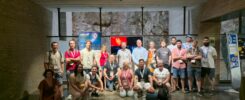
Since July 2025, a continuous observing campaign with the On-Ground Demonstrator (OGD) camera has been taking place at the Javalambre Astrophysical Observatory (OAJ), with observations conducted every night of the year. This sustained effort, involving teams from Instituto de Física de Cantabria (IFCA), Instituto de Estudios Espacialesde Cataluña (IEEC), Universidad de Florida (UF), Facultad de Ciencias de la Universidad de Lisboa, SATLANTIS, and OAJ, aims to reveal the extremely faint structures surrounding nearby galaxies while supporting the scientific preparation of the ARRAKIHS mission.
A Continuous Observing Effort
Since 2025, the On-Ground Demonstrator (OGD) camera has been installed at the Javalambre Astrophysical Observatory (OAJ), in Teruel, Spain, as part of the preparatory activities for the ARRAKIHS space mission.
The OGD is a ground-based adaptation of the iSIM170 camera, a high-performance binocular telescope system designed for the ARRAKIHS mission. Its purpose is to validate key aspects of the instrument’s performance under real observing conditions while contributing to the mission’s scientific objectives.
In July 2025, a dedicated observing campaign began, involving personnel from the Instituto de Física de Cantabria (IFCA-CSIC-UC), SATLANTIS, and the Javalambre Astrophysical Observatory.
Since then, observations have been carried out every night of the year, representing a sustained and coordinated effort by the teams involved. Maintaining such a continuous observing programme requires careful planning, regular monitoring of the instrument, coordination between institutions, and systematic processing of the data acquired.
This long-term commitment is essential to achieving one of the campaign’s main scientific goals: detecting the extremely faint stellar halos and diffuse structures surrounding nearby galaxies.
Building Deep Images, One Night at a Time
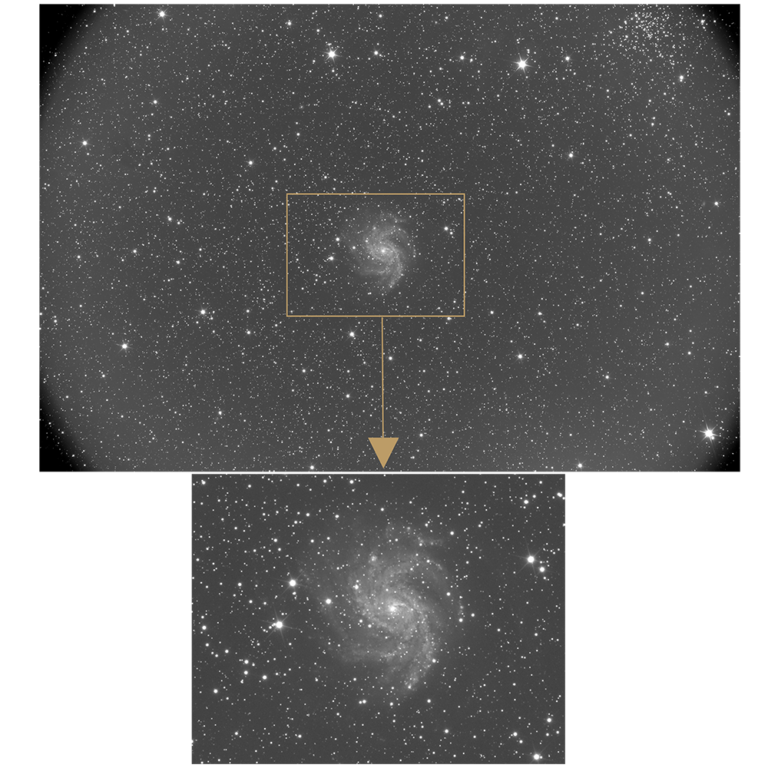
The observing strategy is based on repeatedly imaging a fixed sample of galaxies throughout the year. Each exposure lasts 10 minutes, and the observations acquired over successive nights are progressively combined to build increasingly deep images.
Although a single exposure can reveal the brighter regions of a galaxy, the faint structures in its outskirts often remain hidden in the background noise. Detecting these features requires accumulating a large number of exposures and carefully combining them to improve the signal-to-noise ratio.
This is precisely where the importance of the continuous observing campaign lies. Every night contributes new data, increasing the total exposure time and bringing the team closer to detecting structures that would otherwise remain invisible.
Over months of observations, the accumulated images provide an increasingly detailed view of the faint outskirts of the selected galaxies, potentially revealing stellar halos, tidal streams, and other low-surface-brightness features associated with their evolutionary history.
The success of this approach depends not only on the instrument’s capabilities but also on the sustained observational effort and the careful calibration and processing of the data collected night after night.
A Collaborative Effort Supporting ARRAKIHS
The observing campaign is made possible through the close collaboration of IFCA, SATLANTIS, and OAJ, whose teams contribute to the operation of the instrument, the planning and execution of the observations, and the subsequent analysis of the data.
Beyond the scientific value of the images obtained, this campaign provides valuable experience in the challenges associated with detecting extremely faint galactic structures, including image calibration, background subtraction, and the combination of large numbers of exposures.
These activities are closely connected to the scientific objectives of ARRAKIHS, a mission designed to investigate the low-surface-brightness outskirts of galaxies and improve our understanding of their formation and evolution.
Night after night, the OGD observing campaign at Javalambre demonstrates the dedication and collaborative effort behind ARRAKIHS, turning hundreds of individual exposures into increasingly deep images and paving the way for the mission’s future scientific discoveries.