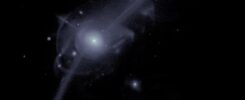
Determining the size of a galaxy requires identifying the point at which its light distribution shows a clear decline, a feature often referred to as its truncation. This boundary offers valuable information about how galaxies form and evolve. Traditionally, measuring this edge has been a time-consuming task that requires detailed visual inspection of deep astronomical images.
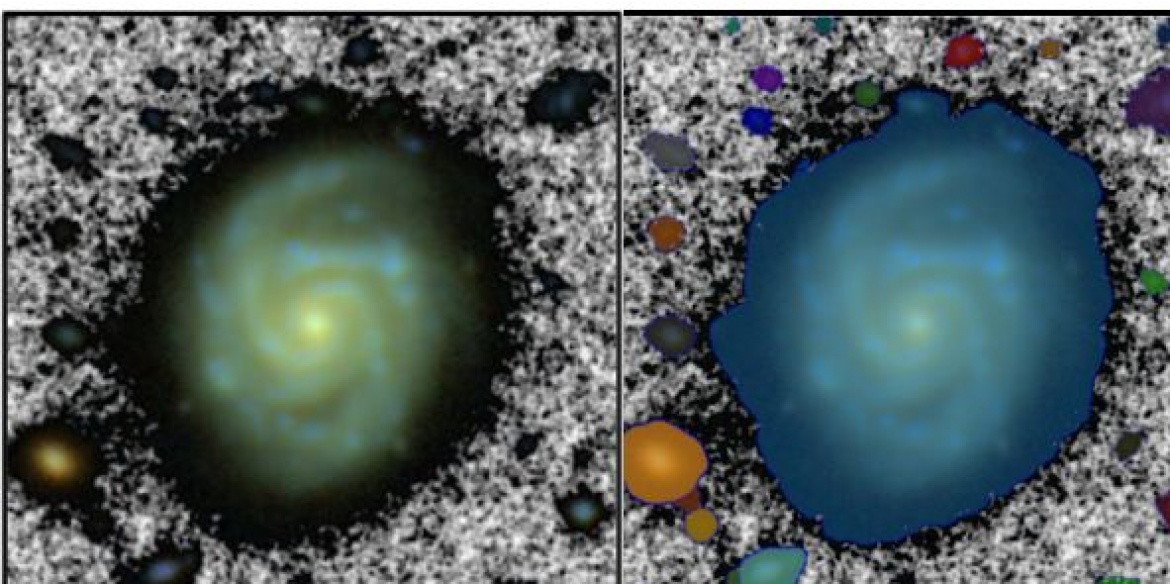
A research team from the University of Valladolid, working together with Jesús Vega-Ferrero, astrophysicist at the Centro de Estudios de Física del Cosmos de Aragón (CEFCA), has evaluated whether a modern foundational Artificial Intelligence model can streamline this task. Their study assesses the performance of the Segment Anything Model (SAM), originally developed by Meta AI for general-purpose image segmentation, when applied to astronomical data.
To assess SAM’s accuracy, the researchers used a sample of 1,047 galaxies with previously established size measurements. The model’s automated results showed an average deviation of only around 1% compared to traditional manual analyses. The images were obtained with the Hubble Space Telescope and processed to resemble the type of observations expected from upcoming wide-field surveys, such as those that will be carried out by the EUCLID mission. The work represents the first application of a foundational segmentation model to the measurement of galaxy sizes in astrophysics, demonstrating that such tools can deliver consistent results with minimal supervision and without specialised training.
Relevance for ARRAKIHS
Beyond validating the method, the study outlines its potential use in the context of ARRAKIHS. As J.Vega-Ferrero note: “This methodology could be applied to ARRAKIHS images not only to measure the sizes of the galaxies observed by the mission, but also to detect and characterize low surface brightness structures around them.”
Since ARRAKIHS is designed to observe the extremely faint outskirts of galaxies, having an automated, robust tool to identify subtle low-surface-brightness features would significantly enhance the mission’s scientific return. AI-driven segmentation could help reveal tidal streams, stellar halos, and other diffuse structures that are essential for tracing galactic interactions and the dark matter distribution.
This study was carried out within the project GEELSBE (“Galactic Edges and Euclid in the Low–Surface-Brightness Era”), led by Fernando Buitrago at the University of Valladolid and funded by the Spanish Ministry of Science and Innovation. The final stages of the work were completed in collaboration with the Centro de Estudios de Física del Cosmos de Aragón (CEFCA). The project opens a new pathway for the application of AI in astronomy and provides a promising avenue for extracting even richer information from future ARRAKIHS observations.
Read the complete paper by J. Vega-Ferrero, F. Buitrago, J. Fernández-Iglesias, S. Raji, B. Sahelices, and H. Domínguez Sánchez, here.