The following is an official statement issued in response to the recent paper by Borlaff et al.
December 5, 2025
The ARRAKIHS Mission Consortium (AMC) to report a significant error in the paper by Borlaff et al. published in December 3 and widely covered through Nature’s press release. The paper presents incorrect and highly misleading conclusions about the impact of Low-Earth Orbit (LEO) satellite trails on the ARRAKIHS mission due to a fundamental mistake in the assumed payload configuration.
Incorrect configuration used
The authors assumed that ARRAKIHS can point as close as 7.6° above the Earth limb. This is incorrect. ARRAKIHS is designed to maintain a minimum Earth limb angle of 55.7°.
This single error leads to an extreme overestimation of satellite-trail contamination, as it models ARRAKIHS as observing around the Earth limb rather than around the zenith, which is the correct configuration for ARRAKIHS. Please note that considering a pointing at 7.6° above the limb is already indicating a deep misunderstanding of the mission concept and operations of ARRAKIHS. The 55.7° minimum angle is dictated by thermal stability considerations.
Corrected results
Using the actual mission design we have re-calculated the results using the same database as that used by Borlaff et al. The results are:
- Average number of satellite trails detected per individual exposure:
- 3 trails for 560,000 satellites (vs. 69 in the paper)
- 5 trails for 1,000,000 satellites (vs. 127 in the paper)
- Field of View affected by trails (%):
- 0,61% for 560,000 satellites (vs. 12.2% in the paper)
- 0,93% for 1,000,000 satellites (vs. 22.3% in the paper)
Please note that ARRAKIHS will combine 900 images per target to obtain the required depth. This process is inherently robust against localized, random contamination of individual exposures. This contamination is expected to be driven for ARRAKIHS by cosmic-rays rather than by satellite trails, even in the worst-case scenario considered by Borlaff et al.
Request
Given the publication of incorrect results and their amplification in global media, we respectfully requested that Nature:
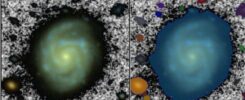
- Issue a correction addressing the erroneous assumptions about ARRAKIHS. In particular, update Figure 2.d showing the ARRAKIHS mock images with the correct number of trails.
- Update the associated press release to prevent further spread of misinformation.
We will provide the full correct calculations to the editorial office on request.
We note that the authors did not contact neither the AMC nor ESA to inform or check on the veracity of their claims for ARRAKIHS.
We emphasize that making wrong assumptions and false statements is counter-productive for denouncing the effects of mega-constellations. We share the concerns regarding the negative effects of mega-constellations of LEO satellites for astronomical observations and remain committed to supporting accurate assessments of LEO-satellite impacts. But such analyses must rely on verified mission parameters—particularly when they affect public understanding of an ESA mission. As demonstrated above, the effect for ARRAKIHS is negligible.
Sincerely,
Rafael Guzmán, AMC Lead
Santiago Serrano, AMC Instrument Coordinator and Deputy Lead
Rebekka Coles-Bieri, AMC Science Coordinator
and the following members of the AMC Science Committee: Mohammad Akhlaghi, Alejandro Camazón Pinilla, Helena Domínguez Sánchez, Henk Hoekstra, Ángela García Agurmánez, Enrique Gaztañaga, María de los Ángeles Gómez Flechoso, Raúl Infante, Koen Kuijken, Francine Marleau, David Martínez Delgado, Yves Revaz, Santi Roca Fàbrega, and Javier Román.