Mission and Spacecraft

Contents

Mission 

Spacecraft Design

Performance & Simulations

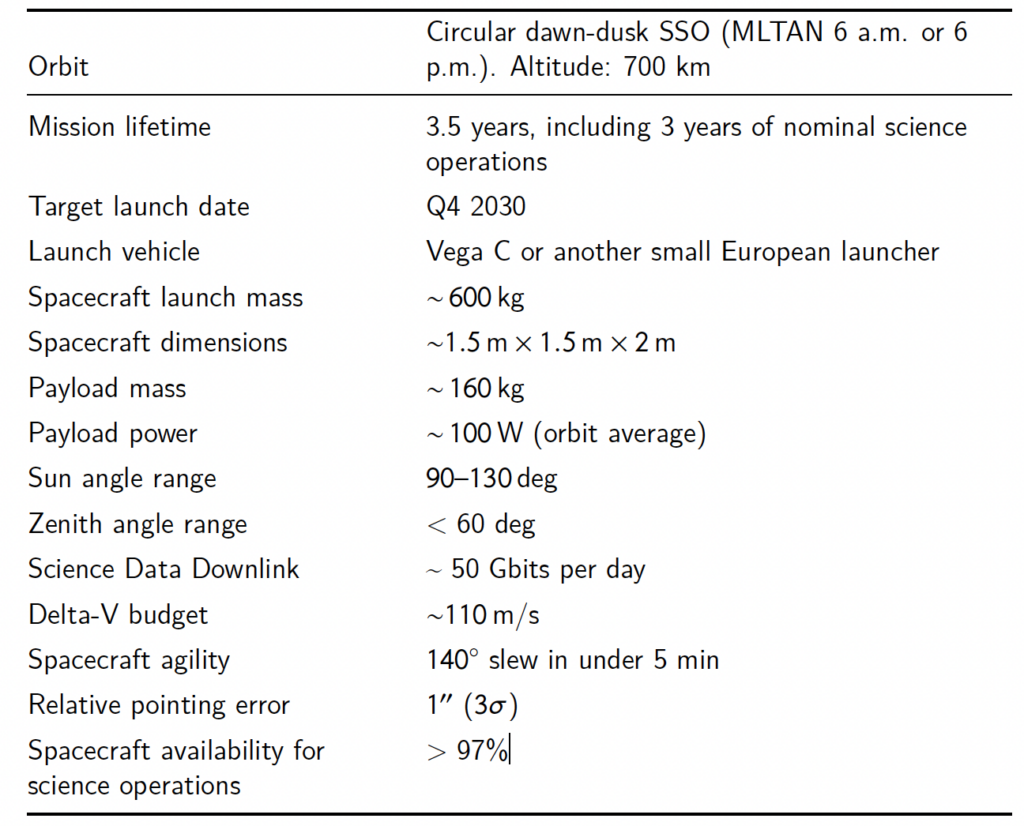
The ARRAKIHS mission is designed as an ESA F-class space observatory dedicated to studying the faint stellar halos and tidal structures surrounding nearby Milky Way–like galaxies. The spacecraft will operate in a 700 km dawn-dusk Sun-synchronous Low Earth Orbit, chosen to provide stable illumination conditions, minimize thermal variations, and satisfy debris mitigation requirements. The mission is planned for launch in 2030, with Vega-C as the baseline launcher, ARRAKIHS will conduct a three-year nominal science mission, with the possibility of extending operations by at least two additional years

Mission

ARRAKIHS will operate in a Low Earth Orbit (LEO) at an altitude of 700 km, following a dawn-dusk Sun-synchronous orbit. This orbit was selected because it provides stable illumination conditions, minimizes thermal variations, and satisfies debris mitigation and radiation requirements.

The mission is scheduled for launch in 2030, with Vega-C as the baseline launcher from Kourou. Alternative compatibility is maintained with future European launchers such as Isar Spectrum and RFA One. The launcher will inject the spacecraft directly in the operational orbit. The nominal science operations phase, which has a duration of 3 years, although it is being designed to be compatible with a potential extension of at least 2 years. 

Key mission parameters are summarized in next table:
The operational timeline includes:

  • Launch and Early Operations Phase (LEOP)
  • Initial Orbit Commissioning (IOC)
  • 1-month Science Performance Verification and Demonstration (SPVD)
  • 3 years of nominal science operations
  • Potential extension of at least 2 additional years

At mission end, the spacecraft will be de-orbited in compliance with ESA debris mitigation regulations.
Spacecraft Design

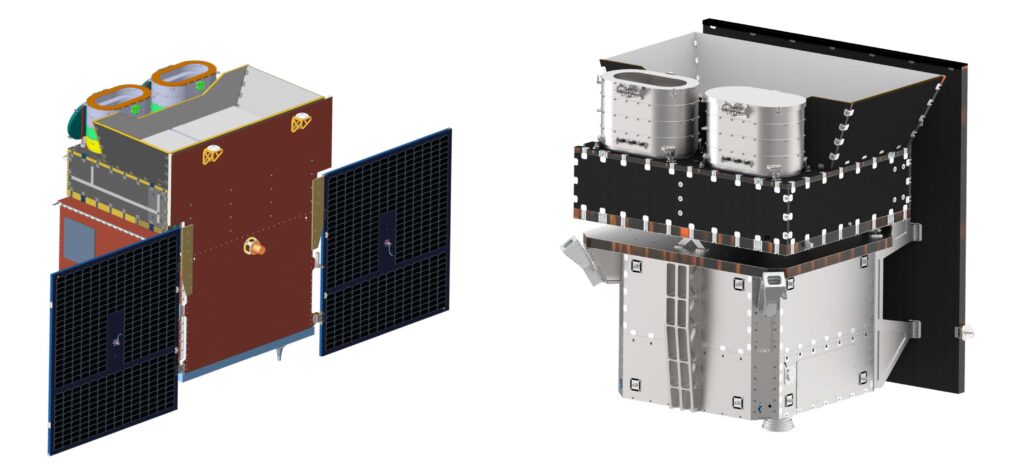
ARRAKIHS spacecraft. Left: Redwire design. Right: AVS design

Performance & Simulations

The mission’s sensitivity was evaluated using a comprehensive noise budget that incorporates both astronomical and instrumental noise sources. These include zodiacal light, Galactic foreground emission, cosmological infrared background, Earthshine, straylight from stars, detector dark current, readout noise, flat-field uncertainties, and cosmic-ray impacts. The results show that ARRAKIHS can reach surface-brightness limits of approximately 30.3–30.6 mag arcsec⁻² in the visible channels and around 29.4–29.7 mag arcsec⁻² in the near-infrared channels, placing the mission among the most sensitive low-surface-brightness observatories ever designed.

Related to the dectector dark current, simulations demonstrated that dark current becomes the dominant noise source when it exceeds roughly 10⁻³ electrons per second per pixel. However, recent detector characterization results indicate that the visible detectors are likely to operate close to this threshold even at end-of-life conditions. Furthermore, the thermal design of the payload allows operation at temperatures lower than the baseline value of 200 K. Lowering the detector temperature to 180 K could reduce the dark current by approximately a factor of sixteen, providing substantial performance margin and supporting the expectation that the system will remain close to a background-limited regime throughout the mission.

Image-quality performance was assessed through detailed optical simulations that included diffraction effects, wavefront errors, thermo-elastic deformations, pointing jitter, detector pixelization, and modulation transfer function analysis. These simulations generated realistic point-spread functions and evaluated key image-quality metrics such as EE50, EE80, and FWHM. The results demonstrate that all four channels satisfy the mission requirements and provide the image quality necessary to resolve faint extended structures while maintaining accurate photometric measurements.

To validate mission performance under realistic observing conditions, the consortium developed the ATREIDS simulation framework. This end-to-end simulator reproduces the complete observational process, generating synthetic images that closely mimic those expected from the spacecraft in orbit. The simulations include target galaxies, background galaxies, Milky Way stars, Galactic dust extinction, Galactic cirrus, zodiacal light, Earthshine, cosmic rays, satellite trails, detector noise, straylight, and realistic point-spread functions. ATREIDS also reproduces the mission observing strategy of 900 individual 10-minute exposures distributed over multiple offsets and dithers, allowing realistic testing of the scientific data-processing pipeline.

The simulated sky background is constructed using state-of-the-art astronomical datasets and models. Background galaxies are generated from Euclid Flagship simulations, stellar foregrounds are based on Gaia, SDSS, 2MASS, and the Besançon Galaxy Model, while Galactic cirrus structures are represented using both observational data and synthetic interstellar-medium models. Zodiacal light is modeled dynamically according to the position of the spacecraft and the time of year, reflecting the fact that observations of a single galaxy may extend over several months and therefore experience changing background conditions

Overall, the mission-performance analysis demonstrates that ARRAKIHS possesses the sensitivity, image quality, thermal stability, and straylight control necessary to achieve its scientific objectives. The combination of advanced detector technology, optimized optical performance, detailed calibration strategies, and highly realistic simulations provides strong evidence that the mission will be capable of detecting and characterizing extremely faint stellar halos and tidal structures around nearby galaxies at unprecedented levels of surface brightness.

Instrument

The spacecraft has two sets of binocular telescopes, consisting of two visible cameras and two infrared cameras. The instrument of the mission undergoes extensive research to fulfill its scientific objectives.

Science

ARRAKIHS will observe ‘ultra-low surface brightness’ galaxy haloes. The population of faint halo satellite galaxies and streams provide the ideal laboratory to test current dark matter models.

Organization

This ARRAKIHS Mission Consortium is a group of researchers and engineers, fundamentally organized along three crucial lines of operation: Instrumentation, Science and Ground Segment.