Entry prepared by S. Brown.
A big question in Astronomy today is understanding how the galaxies we observe form and evolve over time. In our best models, galaxies like our own Milky Way grow by both forming their own stars and accreting many smaller galaxies. These two types of stars have distinct properties; stars born in the galaxy are relatively young and contain many heavy elements, while accreted stars are mainly distributed at the outer part of the galaxy, are older, and contain fewer heavy elements.
This general outline is well established, but we still do not understand many of the finer details of galaxy formation. This is due to the very messy nature of galaxy formation, which involves many different coupled physical processes that vary drastically in temporal and spatial scales. One of our most powerful tools to begin to unpick this mess is the use of galaxy formation simulations. Here we take all the key ingredients for galaxy evolution, such as gravity, fluid dynamics, and explosions from dying stars. We then code up the effects of these processes over time and use large supercomputers to simulate the Universe from its very beginning through to today. You can see an example of these simulations in the video.
A simulation of a Milky Way like galaxy with the EAGLE model. Credit EAGLE collaboration, Jim Geach, Rob Crain.
To create a ‘good’ simulation that makes galaxies that look like the ones we observe in the Universe has been a big challenge for the field. When running a simulation, there are a number of free parameters in our models that we do not know beforehand, but would like to choose such that we get a realistic- looking galaxy. Due to the simulations taking so long to run, often taking months, this becomes a very difficult problem.
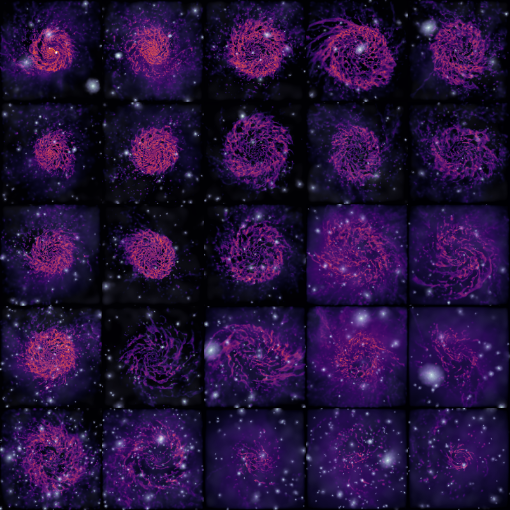
One solution is to train machine learning models that can accurately predict the outputs from the simulations, but in a fraction of a second. This is the approach we took in the ARTEMIS emulator project. In the plot, you can see a visualisation of the same galaxy simulated many times assuming different choices of these free parameters. It can be seen that the galaxy looks very different in these various simulations.
One of the most interesting results from the paper is that when only looking at the central bright part of a galaxy, to the depths to which current observations are sensitive, there are many different combinations of simulation parameters that give us a realistic-looking galaxy today. However, some early analysis suggests that these look quite different in their more diffuse components, which will be accessible with the ARRAKIHS telescope. This is a really exciting result we’re currently working on within the ARRAKIHS team.
Read the complete paper by Brown, Shaun T. et al., here.