Entry prepared by A. Cooper.
December 19, 2025
ARRAKIHS will explore galaxy stellar halos – huge but very tenuous clouds of stars around galaxies, built up as their gravity shreds apart their smaller neighbours.
This first graph shows our predictions for the masses of stellar halos around galaxies similar to our own Milky Way. We know that the Milky Way itself has a stellar halo with a mass equivalent to about one billion stars – reassuringly, that’s around the peak of this curve.
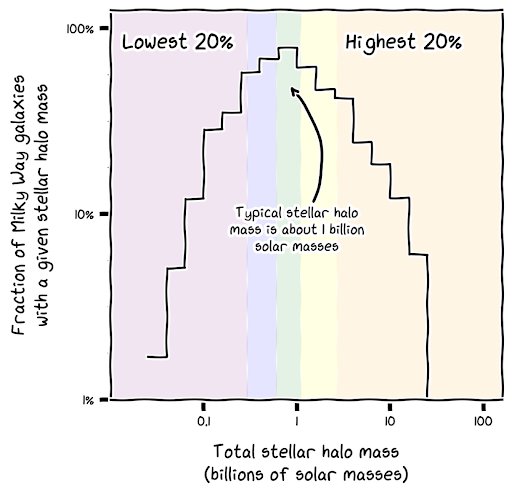
However, we can see there’s a very wide range of possibilities, from 10 times smaller to 10 times larger than the Milky Way stellar halo.
The spread comes from the wide range of different ways that we think a galaxy can grow to resemble the Milky Way today. One of the goals of ARRAKIHS is to measure this distribution of stellar halo masses for real galaxies.
So, how many galaxies should ARRAKIHS observe? This is obviously an important question, but it’s very hard to pin down, not least because the answer probably depends on the things we need the ARRAKIHS observations to understand! Of course, given infinite time and money, we’d look at as many galaxies as possible. Since we don’t have that, what we’re really after is the smallest number that will give us what we need.
We can estimate that number using the models behind the first graph. It’s a bit like doing an opinion poll. We want to make sure we “interview” enough galaxies with the most unusual histories, but we also want our survey to be representative, so we have to pick our galaxies at random (more or less).
Once we’ve decided how many “rare” galaxies we want, we need a big enough sample to give ourselves a realistic chance of hitting that target.
The second graph shows how we put some numbers on this idea. Let’s say we want at least 10 galaxies in the highest (or lowest) 20% of the expected range of stellar halo mass.
We can make up imaginary surveys of a given size at random – the first graph is really telling us the probability of getting a particular stellar halo mass for one random galaxy, which is all we need. The size of an imaginary survey is the number along the horizontal axis of the graph. We can make as many imaginary surveys as we want, to see how the results change — ARRAKIHS itself will be just one such random sample from the real universe!
The red and blue lines on the graph show the average number of galaxies with stellar halos in the top and bottom 20%, for a given survey size (nothing much depends on whether we talk about the top or bottom 20%). Remember, every random survey is different: the bars show the spread in that number across 90% of random surveys of the same size.
Now we can finally answer our question. How many random surveys give us the 10 galaxies we want? This number 10 is the horizontal green line – we look for where that line cuts across the red and blue curves.
We see that, in a survey of about 50 galaxies, we expect to find more than 10 galaxies in our target mass ranges about half the time (50%). 50% sounds a bit risky, so we’ll need more galaxies than that. In a survey of 84 galaxies, we get those 10 galaxies 90% of the time. Put another way, if we look at 84 galaxies, then ARRAKIHS has about a 90% chance of hitting our 10-galaxy target for the top and bottom 20% of stellar halo mass.

Of course, we don’t know what we’ll really get in the end, but 90% seems like a safe enough bet. So our answer is 84!
Of course, exactly how many galaxies ARRAKIHS will observe is going to depend on a lot of factors, but about 80 galaxies fits nicely into the amount of time we hope to be able to operate ARRAKIHS. That’s why, following the ideas above, we’re confident our survey will catch the full range of possibilities for the stellar halos of galaxies like the Milky Way.